
Patient guide · Pioneer Physicians
What to Expect at Urgent Care in Bolingbrook, IL
Here’s what to expect at urgent care with Pioneer Physicians in Bolingbrook, IL: we’re open every day, 8 AM to 8 PM, and you can walk in without an appointment or book a spot online. You check in with a photo ID and insurance card, a provider examines you, any X-ray or rapid test is done on site, and you leave with a plan.
- Open 7 days, 8 AM to 8 PM
- Walk-ins welcome
- X-ray and rapid tests on site
- Kids and adults
- Medicare and Medicaid plans accepted

What to expect at urgent care, step by step
Most visits follow the same order: check in at the front desk, talk with a provider, get any tests you need, then go over the plan before you leave. No appointment is needed, and walk-ins are welcome every day.
Hand your photo ID and insurance card to the front desk. Registration paperwork is filled out there when you arrive, so a sick visit needs no forms done at home. To pick a time instead of walking in, save your spot online before you head out. Doors close at 8 PM, and we’re not a 24-hour clinic. Once we close, the online schedule shows times for tomorrow.
Next, a provider sees you in an exam room. Most tests are done during the same visit. Before you go, the provider walks you through what they found, the treatment and when to follow up.

What to bring to urgent care
Start with your photo ID, your insurance card and a written list of every medicine you take. MedlinePlus also suggests writing down your symptoms, including when they started and what makes them better or worse, so details don’t slip your mind in the exam room.
- A photo ID
- Your insurance card, if you have one
- Every medicine, vitamin and supplement you take, with the doses
- Any allergies, especially to medicines
- Ongoing health conditions and past surgeries
- The names of your regular doctor and your pharmacy
- Short notes on your symptoms and anything you’ve already tried
- For a child, the immunization record, plus a parent or legal guardian to come along
Helpful extras
The FDA offers a free, printable My Medicine Record with space for your medicines, allergies, conditions, doctor and pharmacy. Keep a photo of it on your phone.
If you hurt an arm, leg or back, wear loose, comfortable clothes and leave jewelry at home, since an X-ray may be part of the visit. For a school, sports or DOT physical, bring any forms your school, league or employer gave you. Our patient forms page lists the official Illinois and federal forms.
If you’d like an interpreter, call (630) 914-5373 before you come and ask.
Your urgent care visit in five steps
- 1Arrive or save your spot
We’re open every day, 8 AM to 8 PM. Walk in with no appointment, or save your spot online.
- 2Check in
Show your photo ID and insurance card and fill out your paperwork at the front desk.
- 3See a provider
Talk through your symptoms, medicines and allergies, then get an exam.
- 4Get tests if needed
X-ray, rapid strep, flu and COVID tests, urinalysis and EKG are done here. Blood is drawn here and sent to an outside lab.
- 5Leave with a plan
Go over the treatment, home care, warning signs and when to follow up.
How long is the wait at urgent care?
It depends on how many people arrive before you and what each of them needs, and that shifts hour to hour, so we don’t give a set number here.
You can still plan around it. Saving your spot online lets you choose a time and hold your place before you leave home. Having your ID, insurance card and medicine list in hand keeps check-in simple.
The visit itself varies too. A sore throat with a rapid strep test is a different visit from a wrist injury that needs an X-ray and a splint.
If you’re weighing us against a hospital, know that ER lines work differently. The American Academy of Pediatrics explains that ERs are not first-come, first-served: the sickest patients are seen first, so a minor problem can wait behind serious ones. For a true emergency, go to the ER or call 911 whatever the wait.

Coming in today?
Bring your ID, insurance card and medicine list and walk in any day, or book online if you’d like to pick your arrival time.
What happens in the exam room
The provider starts by listening. Expect questions about when your symptoms began, what you’ve taken for them, your usual medicines, your allergies and your health history. Then comes an exam focused on the problem that brought you in.
Be straight about everything, including smoking or missed doses. MedlinePlus points out that your provider needs to know what is really going on to choose the right care. If a test would help, the provider will explain it first.
X-ray
X-ray is available every day we’re open, and we keep splints and crutches here too, so a possible broken bone can be imaged and supported without a second stop. Tell staff if there is any chance you’re pregnant. You may change into a gown and remove jewelry, glasses or other metal, then hold very still for a few seconds while each image is taken. We do not have CT or MRI.
Rapid strep, flu and COVID tests
These use a swab and are run during your visit. For strep, the swab is taken from the back of the throat and tonsils, and according to MedlinePlus, rapid strep results can be ready in 10 to 20 minutes. The swab can cause brief discomfort or gagging.
Urinalysis and EKG
For a urinalysis, you give a urine sample in a cup, and staff will tell you how to collect it. An EKG records your heart’s electrical activity through small sensors that stick to your arms, legs and chest. You lie still, and MedlinePlus says the test takes only a few minutes.
Blood work
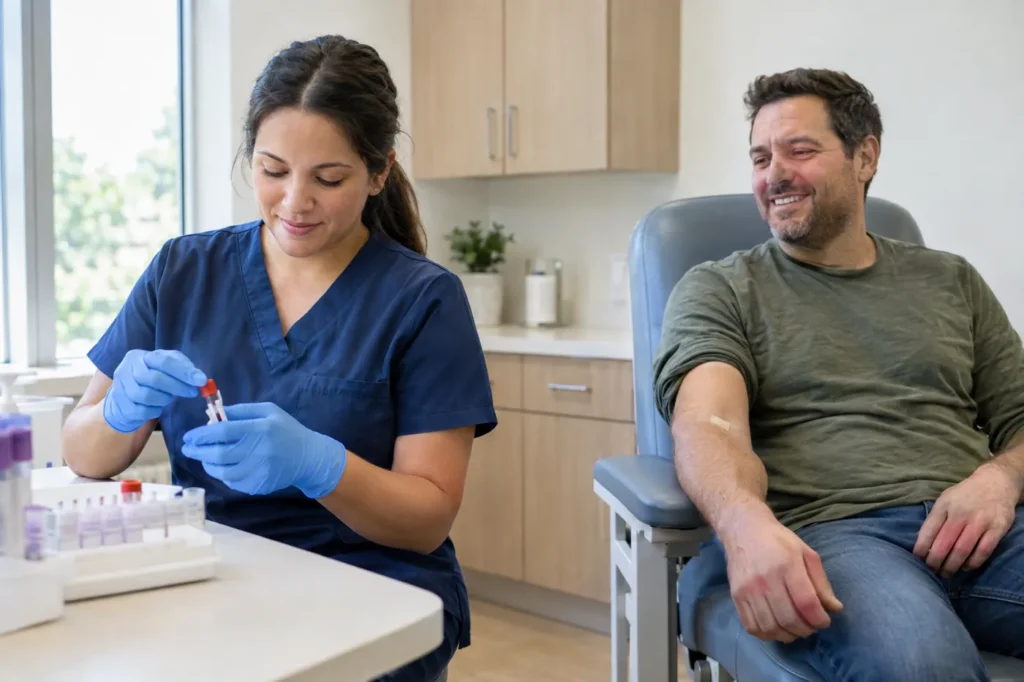
We draw blood on site, but an outside lab runs it, so those results arrive after your visit. Before you leave, ask how you’ll hear about them.

Bringing your child to urgent care
Our pediatric urgent care sees patients from infancy through the teen years. When you can, the AAP suggests calling your pediatrician first, because many concerns can be handled by phone and the office can help you decide where your child should be seen.
Come ready to share what the AAP suggests having on hand for any visit outside the pediatrician’s office: whether shots are up to date, any medicine allergies, every medicine your child takes and when the last dose was given, and ongoing conditions such as asthma or diabetes. The AAP also says it’s fine to give a fever or pain reliever before you come. Just note the time and the amount.
Plan for a parent or legal guardian to come along. If a grandparent, sitter or other adult will bring your child, call us first to ask what we need. A favorite toy or blanket can calm a nervous child.
Childhood vaccinations aren’t offered here. Your child’s regular doctor handles routine shots, as do the county health departments in Will and DuPage counties. After the visit, ask how to get a copy of the notes for your pediatrician. The AAP says sharing them helps avoid missed follow-up and repeat testing.

Insurance, self-pay and paying for the visit
We accept these plans: Aetna, Cigna, Humana, UnitedHealthcare, Medicare, Blue Cross Blue Shield of Illinois, and Illinois Medicaid coverage through HFS, Meridian, CountyCare, Molina or YouthCare. Please call to confirm your specific plan before your visit. What you owe comes down to your plan’s copay, deductible and coinsurance, and our insurance page has more on each plan.
No insurance? You can still be seen as a self-pay patient. You pay for the visit plus any tests your care calls for, such as an X-ray or lab work. Call for current self-pay pricing, and if cost matters, ask about added charges before a test is done.
In general, the AAP notes that urgent care costs far less than an ER, though it can cost more than a visit to your regular doctor’s office. MedlinePlus adds that your insurance may require a higher copayment for emergency department care.
Before you leave, and after
Before you head out, make sure you know four things: what the provider thinks is going on, what to do at home, which warning signs call for a return visit or a trip to the ER, and when to see your regular doctor. If something isn’t clear, ask again until it is. MedlinePlus suggests taking notes, or bringing someone who can take them for you, and asking for written instructions if you need them.
If you might need a prescription, tell us which pharmacy you use. If you feel worse after you get home, call us during open hours or come back in, and call 911 for any of the emergency signs below.

The Pioneer walk-in visit
How a visit works
- Step 1Walk in or save your spot
No appointment needed. You can also save your spot online before you leave home.
- Step 2Check in
Bring a photo ID, your insurance card and a list of the medicines you take.
- Step 3See a provider
Get examined, with X-ray and rapid tests on site when you need them.
- Step 4Leave with a plan
You go home with a care plan and clear next steps.
Why families in Bolingbrook choose Pioneer
Walk-in care that fits real life
Open 7 days a week
8 AM to 8 PM, weekends included, so a Saturday sore throat does not have to wait until Monday.
X-ray and tests on site
X-ray every day we are open, plus rapid strep, flu and COVID tests, urinalysis and EKG.
Care for kids and adults
From infants through the teen years, and adults of every age, in one clinic.
Insurance and self-pay
Aetna, BCBS of Illinois, Cigna, Humana, Medicare, Illinois Medicaid plans and UnitedHealthcare. Call to confirm your plan.
Questions and answers
Questions we hear often
Still not sure? Call (630) 914-5373 and we will help you decide.
How long does an urgent care visit take?
There’s no set length. It depends on how many patients arrive ahead of you and what your visit involves. A simple illness visit is usually shorter than an injury that needs an X-ray and a splint. To have more say over timing, book online and pick an arrival time.
Do I need an appointment, or can I walk in?
You can walk in. Pioneer Physicians in Bolingbrook is open seven days a week, 8 AM to 8 PM, and walk-ins are welcome with no appointment needed. To get a set time instead, book online. After closing, the online schedule offers next-day slots.
Can I check urgent care wait times before I go?
Not on this page. Waits shift through the day with how many people come in and what they need. Booking online lets you pick a time slot before you leave home, and you can call (630) 914-5373 with questions about coming in today.
What should I bring to urgent care?
Bring your photo ID and, if you’re insured, your insurance card. Add a written list of every medicine, vitamin and supplement you take with the doses, plus any allergies and the names of your regular doctor and pharmacy. For a child, bring the immunization record.
What if I forget my insurance card?
Come in anyway. Forgetting the card doesn’t stop you from being seen, and self-pay is available if it comes to that. Call (630) 914-5373 to ask how to handle billing for that visit, and bring a photo of the card or your member ID number if you can.
Can I go to urgent care without insurance?
Yes. Our Bolingbrook clinic sees self-pay patients, and the bill covers the visit plus any tests your care calls for, such as an X-ray or lab work. We don’t list prices online, so phone (630) 914-5373 to ask about current self-pay rates, and if cost matters, ask what a test adds before it’s done.






Sources for this page
- Talking With Your Doctor. MedlinePlus, U.S. National Library of Medicine.
- When to use the emergency room: adult. MedlinePlus, U.S. National Library of Medicine.
- My Medicine Record (Form FDA 3664). U.S. Food and Drug Administration.
- 10 Things for Parents to Know Before Heading to the ER. American Academy of Pediatrics, HealthyChildren.org.
- Urgent Care for Children and Teens: AAP Policy Explained. American Academy of Pediatrics, HealthyChildren.org.
- Bone X-ray (Radiography). RadiologyInfo.org, ACR and RSNA.
- Strep A Test. MedlinePlus, U.S. National Library of Medicine.
- Electrocardiogram. MedlinePlus, U.S. National Library of Medicine.