
Walk-in care · Bolingbrook, IL
Walk-In X-Ray at Urgent Care in Bolingbrook, IL
Pioneer Physicians Urgent Care offers walk-in X-ray in Bolingbrook, IL, with no appointment needed. We’re open 7 days a week, 8 AM to 8 PM, and X-ray is on site every day we are open. A provider examines you first, and if you need an X-ray, it’s taken here during the same visit.
- Open 7 days, 8 AM to 8 PM
- Walk-ins welcome
- X-ray and rapid tests on site
- Kids and adults
- Medicare and Medicaid plans accepted
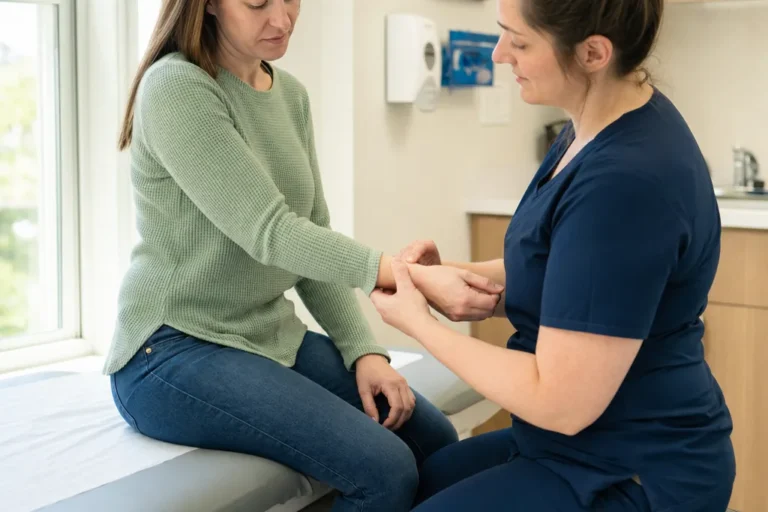
Can I get a walk-in X-ray in Bolingbrook today?
Yes. For an injury or illness, the X-ray happens as part of your urgent care visit. A provider asks what happened, examines you and decides whether a picture will help. If it will, the X-ray is done in our clinic. As an urgent care with X-ray on site, we can check a hurt wrist or ankle without sending you to an imaging center first.
You can walk in any day, Saturday and Sunday included, or save your spot online. If you get hurt after 8 PM and it isn’t an emergency, the booking page shows next-day times.
If you already have an X-ray order from another doctor, or you want a copy of your images, call (630) 914-5373 to ask before you make the trip.

When an injury needs an X-ray
An X-ray is usually needed when the exam suggests a bone could be broken or a joint could be out of place. Sprains and fractures can look alike, since both cause pain, swelling and bruising.
MedlinePlus lists the signs of a broken bone as a limb that looks out of place, swelling or bruising, and trouble moving it or bearing weight. Findings like these make an X-ray worth doing:
- Pain right over a bone after a fall, a twist or a hit
- Swelling or bruising around the injury
- Trouble putting weight on a foot or leg, or using a hand or arm
- A child who won’t use an arm or leg after an accident
The Ottawa ankle rules
For ankle and foot injuries, many clinicians use a checklist called the Ottawa ankle rules. As described by the American Academy of Family Physicians, an X-ray is advised when there is pain around the ankle bones or in the middle of the foot, plus either tenderness at certain spots on the bone or being unable to take four steps both right after the injury and at the exam. Studies show the rules catch nearly all ankle and midfoot fractures in adults and in children as young as 5.
If the X-ray shows no break, our page on sprains and strains covers home care and what recovery usually looks like.
Your walk-in X-ray visit, step by step
- 1Arrive
Walk in any day, or save your spot online. No appointment needed.
- 2Exam
A provider asks how you got hurt and examines the injury.
- 3X-ray
If you need one, it’s taken here. Hold still for a few seconds per picture.
- 4Support
Get a splint or crutches on site if your injury needs them.
- 5Plan
Leave with home care advice and any follow-up you need.
What an X-ray shows and what it can miss
An X-ray gives a clear picture of bone, but it shows much less of muscles, tendons and ligaments. Bone blocks more of the X-ray beam, so it shows up white, while soft tissue looks gray and air looks black. RadiologyInfo, the patient site of the American College of Radiology and RSNA, calls bone X-ray the fastest and easiest way to check for fractures and dislocated joints.
X-rays aren’t only for injuries. MedlinePlus notes that a chest X-ray can detect pneumonia, so your provider may suggest one when a cough, fever or trouble breathing needs a closer look.
The trade-off is soft tissue. A torn knee ligament or a rotator cuff tear in the shoulder may not show on an X-ray at all. RadiologyInfo says MRI is often more useful for those injuries and can also find small fractures and bone bruises that an X-ray misses. A normal X-ray rules out many breaks, but it doesn’t always explain all of the pain.
We don’t do CT or MRI
We do not do CT scans or MRI here. If your provider thinks you need one, they’ll explain why and talk with you about next steps. If you have a question about ultrasound, call us to ask.
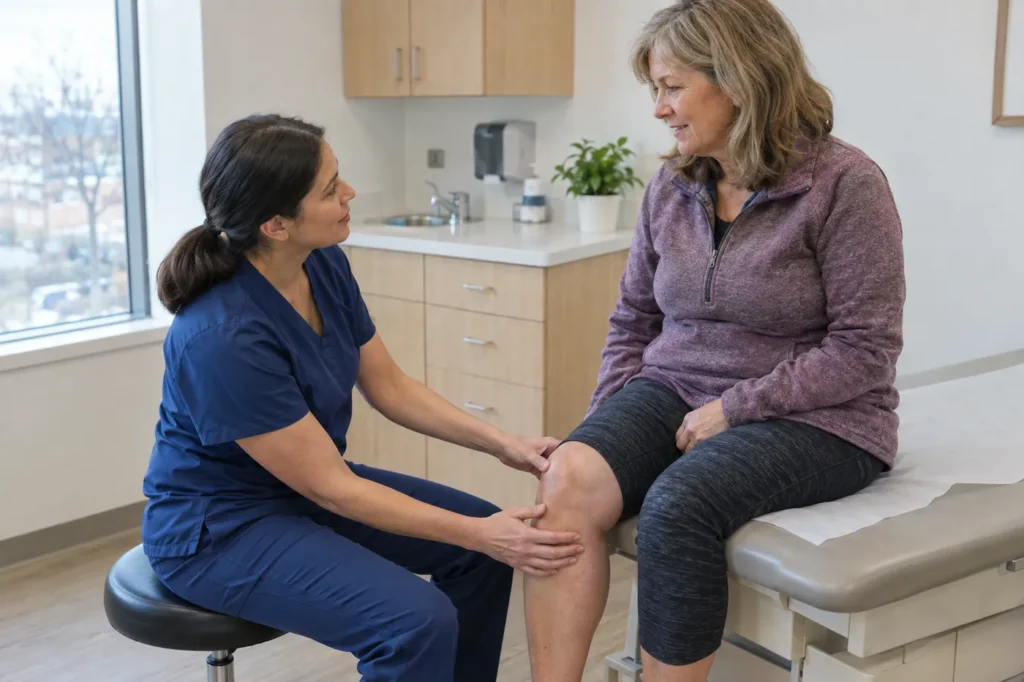
What happens during your X-ray visit
You check in, see a provider, have the X-ray if you need it, and leave with a plan. Before the picture, you may be asked to remove jewelry, glasses and anything metal near the area, because metal can get in the way of the image. You may change into a gown, and you may be given a lead apron to cover other parts of your body.
For each picture, you hold very still for a few seconds, and for some views you’ll hold your breath. RadiologyInfo says two or three pictures taken from different angles are typical for a bone X-ray. Taking the picture doesn’t hurt, though RadiologyInfo notes that holding an injured arm or leg still in one position can be uncomfortable.
After the X-ray, your provider talks with you about what comes next. That may be a splint or crutches, advice for home care, or follow-up with your regular doctor or a specialist.
What to bring and wear
Bring a photo ID, your insurance card if you have one, and a list of the medicines you take. Wear loose, comfortable clothing and leave jewelry at home if you can. If there is any chance you are pregnant, tell your provider before the X-ray.
Hurt a wrist, ankle or knee today?
Walk in any day for an exam and on-site X-ray, or save your spot online and come in at your time.
Splints and crutches after your X-ray
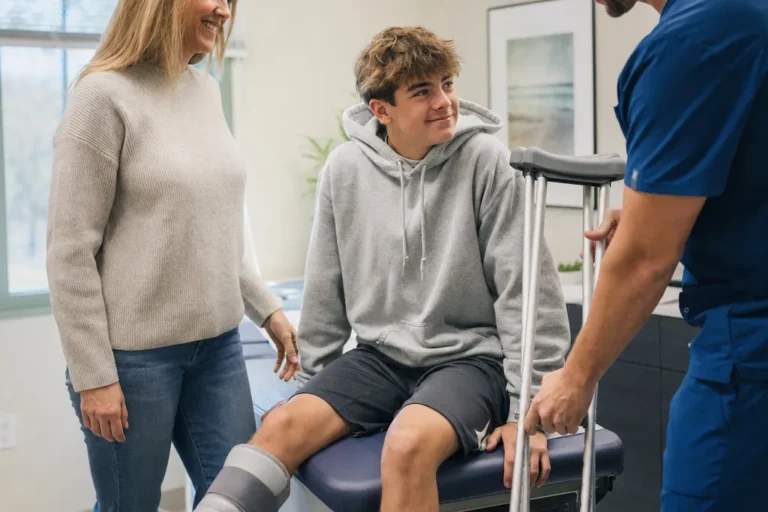
If your injury needs support, we have splints and crutches here. A splint is a firm support held on with an elastic wrap. Unlike a cast, it doesn’t wrap all the way around, which leaves room for swelling in the first days after an injury. That is why the American Academy of Family Physicians calls splinting the preferred way to hold a fresh fracture still in acute care. Some breaks later need a cast or a visit with a bone specialist.
Crutches take weight off a hurt leg or foot, but only if they fit. MedlinePlus advises leaving about 2 fingers, or an inch, between the underarm and the top of the crutch, with the handgrips at wrist level so the elbows bend slightly. Don’t lean on the underarm pads, since pressure there can hurt nerves and blood vessels.
Caring for a splint at home
Keep the injured arm or leg raised to ease pain and swelling. Keep the splint dry, and don’t push anything inside it to scratch an itch. The AAFP notes that ice can go on over a splint for 15 to 30 minutes at a time.
How much radiation is in an X-ray?
Very little. One adult chest X-ray gives about the same dose as 10 days of the natural background radiation everyone gets from the environment.
People in the U.S. get about 3 mSv of natural background radiation a year, according to RadiologyInfo. The mSv, or millisievert, is the unit used to compare doses. An adult chest X-ray is about 0.1 mSv. An X-ray of a hand or foot is less than 0.001 mSv, about the same as less than 3 hours of background radiation.
RadiologyInfo notes a slight chance of cancer from too much radiation, but says the benefit of an accurate diagnosis far outweighs that risk at X-ray doses. It adds that no radiation stays in your body after the exam. An X-ray should still be done only for a good medical reason, using the lowest dose that gives a clear picture.
If you are or might be pregnant
Tell your provider before the X-ray. Many tests are avoided during pregnancy, and when an X-ray is needed, extra steps are taken to limit the baby’s exposure.
X-rays for babies, kids and teens
Children can get an X-ray here. We see kids from infancy through the teen years. MedlinePlus advises that if a young child won’t put weight on an arm or leg after an accident, won’t move it, or it looks misshapen, you should assume the bone is broken and get medical help.
Kids need to hold still so the picture isn’t blurry. Older children may be asked to hold their breath for a few seconds, and babies may need help keeping still. RadiologyInfo says the actual exposure usually lasts less than a second. Sometimes a picture of the uninjured arm or leg, or of a child’s growth plate, is taken for comparison.
For kids, equipment settings aim for the lowest dose that still gives a good image. For fevers, ear pain and other childhood illnesses, see our pediatric urgent care page.

Insurance and self-pay for X-ray visits
We accept many common plans, and you can pay for the visit yourself if you don’t have insurance. Plans we accept include Aetna, Cigna, Medicare, Blue Cross Blue Shield of Illinois, UnitedHealthcare, Humana and Illinois Medicaid plans (HFS, Meridian, CountyCare, Molina and YouthCare). Coverage varies by plan, so call (630) 914-5373 to confirm your specific plan before you come.
Without insurance, your cost is the visit plus any tests you need, such as an X-ray, so it depends on what the exam shows. Call for current self-pay pricing.

Coming from a nearby town
Our clinic at 148 S Bolingbrook Dr is a short drive from several nearby towns. Romeoville is about 10 minutes away and Woodridge about 11. Lemont, Darien and Lisle are each about 14 minutes, downtown Plainfield about 15, Downers Grove about 16, Lockport about 17 and downtown Naperville about 18, with south Naperville closer. See our pages for X-ray near Downers Grove and X-ray near Lockport.
The Pioneer walk-in visit
How a visit works
- Step 1Walk in or save your spot
No appointment needed. You can also save your spot online before you leave home.
- Step 2Check in
Bring a photo ID, your insurance card and a list of the medicines you take.
- Step 3See a provider
Get examined, with X-ray and rapid tests on site when you need them.
- Step 4Leave with a plan
You go home with a care plan and clear next steps.
Why families in Bolingbrook choose Pioneer
Walk-in care that fits real life
Open 7 days a week
8 AM to 8 PM, weekends included, so a Saturday sore throat does not have to wait until Monday.
X-ray and tests on site
X-ray every day we are open, plus rapid strep, flu and COVID tests, urinalysis and EKG.
Care for kids and adults
From infants through the teen years, and adults of every age, in one clinic.
Insurance and self-pay
Aetna, BCBS of Illinois, Cigna, Humana, Medicare, Illinois Medicaid plans and UnitedHealthcare. Call to confirm your plan.
Questions and answers
Questions we hear often
Still not sure? Call (630) 914-5373 and we will help you decide.
Do I need an appointment for an X-ray?
No. X-ray is part of a walk-in urgent care visit, and a provider decides during the exam whether you need one. We’re open 7 days a week, 8 AM to 8 PM, and walk-ins are welcome. You can also save your spot online, and after 8 PM the booking page shows next-day times.
Do you do CT scans, MRI or ultrasound?
We do not do CT scans or MRI. If your provider thinks you need a CT or MRI, they’ll explain why and talk with you about next steps. For questions about ultrasound, call (630) 914-5373 to ask before you come in.
Can I get a chest X-ray here?
Yes, when your provider decides one is needed during a visit for an illness, such as a cough with fever or trouble breathing. If you need a chest X-ray for work, school or another outside requirement, call (630) 914-5373 to ask before you come in. For chest pain or severe trouble breathing, call 911 instead.
Can urgent care tell if a bone is broken?
Urgent care can check for one. A provider examines the injury, and if a break is possible, an X-ray is taken here during the same visit, since X-rays are commonly used to check for fractures. Some small breaks and many ligament injuries don’t show well on X-ray, so your provider may still splint the area or suggest follow-up imaging.
How do I know if my ankle needs an X-ray?
Clinicians often use a short checklist called the Ottawa ankle rules. It calls for an X-ray when the ankle or midfoot hurts and either certain spots on the bone are tender or you couldn’t take four steps after the injury. The rules miss very few fractures, so if you can’t walk on the ankle or the pain isn’t easing, have it checked.
Is an X-ray safe for my child?
X-rays use a small dose of radiation, and for children the equipment settings aim for the lowest dose that still gives a clear image. RadiologyInfo notes the exposure itself usually lasts less than a second, and that exams should be done only for a good medical reason. We see children from infancy through the teen years.
How much does an X-ray cost without insurance?
Self-pay is available. Your cost is the visit plus any tests you need, which can include an X-ray, so the total depends on what the exam shows. Call (630) 914-5373 for current self-pay pricing. If you have insurance, bring your card and call to confirm your specific plan.







Sources for this page
- Radiation Dose from X-Ray and CT Exams. RadiologyInfo.org (American College of Radiology and RSNA).
- Bone X-ray (Radiography). RadiologyInfo.org (American College of Radiology and RSNA).
- Pediatric X-ray Exam. RadiologyInfo.org (American College of Radiology and RSNA).
- X-Rays. MedlinePlus, National Library of Medicine.
- Broken bone. MedlinePlus Medical Encyclopedia, National Library of Medicine.
- Crutches and children: proper fit and safety tips. MedlinePlus Medical Encyclopedia, National Library of Medicine.
- Update on Acute Ankle Sprains (Ottawa ankle rules). American Family Physician, American Academy of Family Physicians.
- Principles of Casting and Splinting. American Family Physician, American Academy of Family Physicians.