
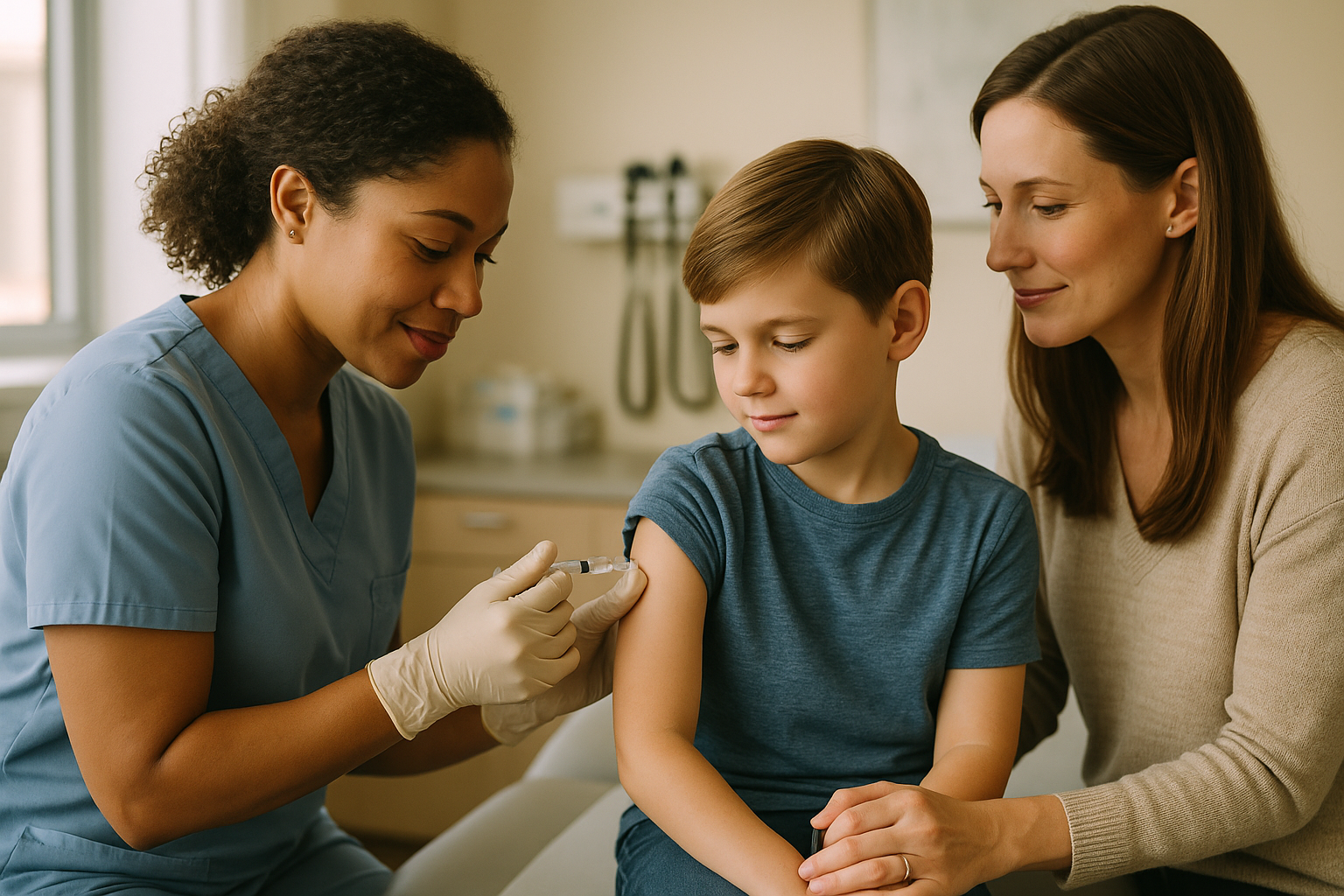
Illinois does not treat school immunization records as a suggestion. State law requires documentation at specific grade levels, and a student who shows up without either proof or a properly documented exemption can be excluded from school until the requirement is met. Not warned. Excluded.
The good news for the 2026-2027 school year is that nothing changed. In August 2026 the Illinois Department of Public Health reaffirmed the existing childhood immunization schedule, so the requirements families planned around last year still apply. This guide covers which grades trigger a records check, what is required at each stage, and the two timing rules that make August far less stressful.
Which grades require immunization proof in Illinois?
Proof of vaccination is required to begin pre-K, kindergarten, 6th grade and 12th grade, and for any student transferring into an Illinois school. Students without proof or a properly documented exemption shall be excluded from school until they meet the requirement. Requirements are unchanged for the 2026-2027 school year.
We care for patients from Bolingbrook and the surrounding communities including Romeoville, Woodridge, Naperville, Plainfield, Downers Grove, Lockport, Lisle, Darien and Lemont. Our clinic is at 148 S Bolingbrook Dr, open 7 days a week from 8 AM to 8 PM, with walk-ins welcome. If you are dealing with back-to-school immunizations, you can walk in or book a visit online.
The four checkpoints
Illinois does not check immunization records every year. It checks at four transition points, and at each one a student has to show the doses required for that stage in addition to everything required at the stage before it. The requirements stack.
| Stage | What is added at this stage |
|---|---|
| Child care, preschool, early childhood, pre-K | DTaP: 4 doses (3 by 1st birthday, 1 more by 2nd birthday). Hep B: 3 doses (3rd on or after 24 weeks of age). Hib: 3-4 doses. Pneumococcal (PCV): 4 doses. Polio (IPV): 3 doses. MMR: 1 dose on or after 1st birthday. Varicella: 1 dose on or after 1st birthday. |
| Kindergarten (entry to school) | DTaP: 4 or more doses, last booster on or after the 4th birthday. Polio (IPV): 4 doses, 4th on or after the 4th birthday. MMR: 2 doses, 1st on or after the 1st birthday and the 2nd at least 28 days later. Varicella: 2 doses, same spacing. (Hib and PCV are not required for kindergarten entry.) |
| 6th grade (middle school) | Adds Tdap: 1 dose on or after the 11th birthday. Hep B: 3 doses. Meningococcal (MCV4): 1 dose on or after the 11th birthday. In addition to kindergarten requirements. |
| 12th grade (high school senior) | Adds Meningococcal (MCV4): 1 dose on or after the 16th birthday. In addition to 6th grade requirements. |
Reproduced from the Illinois Chapter of the American Academy of Pediatrics summary of IDPH minimum requirements. The source document notes that total doses may differ and must be verified by your doctor if a child is on a catch-up schedule. Confirm your child’s specific situation with your provider or school nurse.
Data: Illinois Chapter, AAP: Immunization Requirements by Grade (PDF, October 2025)
The exclusion rule is the part to take seriously
Most immunization guidance is written in the language of recommendation. The Illinois school requirement is not. A student who cannot produce documentation of the required immunizations, or a properly documented exemption, shall be excluded from school until the requirement is satisfied.
In practice that means a missed dose is not just a health question, it is an attendance question. It can pull a child out of class, out of practice, and in some cases out of a season. Districts generally do communicate ahead of deadlines, but the responsibility for producing the record sits with the family.
Two timing rules that make this easy
These two rules do more to reduce back-to-school stress than anything else in this article, and they are both underused.
- 1Vaccines can be given a full year early
Required school vaccinations can be administered up to one year before the start of the school year in which they are needed. A dose your child needs for 6th grade can be given the summer before 5th grade ends. - 2Catch-up is always available
If a child has missed vaccinations, they can catch up. A gap in the record is not a permanent problem, but catch-up schedules take time and sometimes multiple visits spaced weeks apart. - 3Request records before you need them
Records may be spread across a former pediatrician, a former state, or a former school district. Requesting them in spring rather than August is the single easiest thing on this list.
The catch-up point deserves emphasis because it is where the timing rules interact. Some catch-up series require doses separated by four weeks or more. If a family discovers a gap in mid-August, the calendar, not the clinic, becomes the constraint. Discovering the same gap in June makes it a non-event.
Recommended, but not required
Several vaccines are recommended for school-age children in Illinois without being required for school entry. Parents sometimes read “not required” as “not important,” which is a mistake, but it is worth knowing which category a given vaccine falls into so you can make an informed decision rather than a rushed one.
| Vaccine | Recommendation |
|---|---|
| Influenza (flu) | 1 dose every year for everyone aged 6 months and older. |
| COVID-19 | 1 dose every year for everyone aged 6 months and older. |
| HPV | Recommended for everyone between ages 9 and 26, ideally at ages 9 to 12. Depending on the timing of the first dose, 2 or 3 doses may be needed. |
| Hepatitis A | Recommended as a 2-dose series beginning at 12 months of age. |
| Meningococcal B (MenB) | Not required for Illinois school entry, but required by some college programs. |
The MenB note matters for families with a senior. A vaccine that is optional for high school can become mandatory for a specific university’s housing or enrollment requirements, so check the college’s own health form.
Data: Illinois Chapter, AAP: Immunization Requirements by Grade (PDF, October 2025)
Exemptions, and what documentation actually means
Illinois allows medical and religious exemptions, and both require documentation rather than a verbal request. An exemption is a formal filing with specific paperwork, and an undocumented objection is treated the same as a missing record for attendance purposes.
If you are considering an exemption, start the conversation with your provider and your school nurse well before the deadline. This is not a form to discover you need during the first week of school. We are not the right place to process a religious exemption, but we can tell you what your record currently shows and what the state requirement is for your child’s grade.
What we can and cannot do at a walk-in clinic
Being straightforward about scope: we do not give childhood vaccinations. We can review your child’s record against the requirement for their grade during a school physical and complete the state health examination form, and routine shots come from your child’s doctor or the Will County or DuPage County health department. For a child on a complex catch-up schedule, or one with a medical condition that affects vaccine choice, coordination with a regular pediatrician is genuinely better care, and we will say so.
What a walk-in clinic is good at is the specific August problem: you have a deadline, the school has flagged a gap, and you need someone to look at the record and act on it today. We are open seven days a week, 8 AM to 8 PM, and you do not need an appointment.
A short August checklist
- Find your child’s immunization record now, before you need it.
- Check their grade against the four checkpoints above. Remember the requirements stack.
- If your child is entering 6th grade, look specifically for Tdap and MCV4 on or after the 11th birthday.
- If your child is a senior, look for an MCV4 dose on or after the 16th birthday, and check any college health form for MenB.
- If anything is missing, book or walk in early enough to allow for a spaced catch-up series.
- Submit documentation to the school and confirm they received it. Do not assume.
Nothing about the requirements changed this year, which means the only variable is timing. Handle it in spring and it is paperwork. Handle it in the last week of August and it can become an attendance problem.
How to actually get your child’s immunization record
The most common obstacle is not a missing vaccine. It is a missing piece of paper. Families move, pediatric practices close or merge, and records end up scattered across several providers and sometimes several states.
Illinois maintains a statewide registry for exactly this problem. I-CARE, the Illinois Comprehensive Automated Immunization Registry Exchange, is an IDPH web-based system that lets health care providers share the immunization records of Illinois residents with other providers statewide.
- 1Ask the provider who gave the doses
Any Illinois practice participating in I-CARE can usually pull a consolidated record rather than only what is in their own chart. - 2Request it from IDPH directly
For a minor, a parent or guardian submits the Immunization Record Request form. IDPH lists 217-785-1455 (option 1) and DPH.IZRecordRequests@Illinois.gov as contact points for record requests. - 3Check the school you are leaving
If your child attended another Illinois school, that district’s health office already had to hold compliant documentation, so they are often the fastest source.
Records can be shared with providers, schools and employers with permission. Families who prefer not to have vaccine information stored in the registry can submit an opt-out form.
Two practical notes. Adults looking for their own records have a separate IDPH tool, Vax Verify, rather than the minor record-request process. And if you have moved from another state, the CDC maintains a directory of state immunization registry contacts, which is usually faster than calling old clinics one at a time.
What a catch-up visit actually looks like
Parents sometimes delay dealing with a gap because they imagine a difficult conversation or a long series of appointments. In practice a catch-up visit is straightforward, and knowing the shape of it helps.
A clinician reviews the existing record against the requirement for your child’s grade, identifies which doses are genuinely missing, and checks the spacing rules. Several vaccines have minimum intervals between doses, which is the part families cannot compress. Where a series requires four weeks between doses, no amount of urgency shortens it.
The source we are working from is explicit on one point worth repeating: the total number of doses may differ and must be verified by your doctor if a child is on a catch-up schedule. This is why the table earlier in this article is a planning tool rather than a substitute for having someone look at your child’s actual record. A child who received doses early, or out of order, or in another country, may need a different count than the standard schedule shows.
Transfer students carry the heaviest load
Any student transferring into an Illinois school needs immunization documentation, regardless of grade. This is the checkpoint families overlook, because the other four are tied to predictable grade transitions and this one can happen in the middle of a school year.
If you are moving into the Bolingbrook area from another state, expect to find at least one gap. It is not a reflection of poor care. State schedules differ, and Illinois requires some doses on or after a specific birthday rather than simply at some point, which is a rule that catches otherwise fully vaccinated children. The 6th grade Tdap and MCV4 doses both have to be on or after the 11th birthday. A dose given at age ten does not count toward that requirement even though the child received the vaccine.
Do not forget dental and vision
Illinois has two separate examination requirements that run alongside immunizations and the health physical, on their own calendars.
- Dental examination: required for kindergarten, 2nd, 6th and 9th grade, due before May 15 of that school year, completed by a licensed dentist within 18 months of that date.
- Vision examination: required for children entering kindergarten and for students transferring from a school outside Illinois for the first time, due before October 15 or within 30 days of enrollment for new out-of-state students.
Both need a different professional than the one completing your immunizations. Neither is satisfied by a school screening. We mention them here only because the family that gets caught out in May is almost always the family that assumed the August paperwork was the whole job.
State law versus your district’s calendar
There is a difference between the legal requirement and the date your school asks for the paperwork, and the second one is what actually affects your week.
State law defines what is required and establishes that noncompliant students are excluded until they meet it. Districts set their own submission deadlines, reminder schedules, and exclusion procedures on top of that. Those dates are often earlier than the start of school.
Bolingbrook families are served primarily by Valley View School District 365U, and neighboring communities fall under a range of other districts. Because packets and deadlines vary, confirm requirements with your own school’s health office. What does not vary is the four-checkpoint structure and the stacking rule described above.
What to do this week
If your child is entering one of the four checkpoint stages, the whole task reduces to three moves, and none of them require a doctor’s appointment to start.
- Locate the record. Check your own files first, then the previous provider, then I-CARE through IDPH.
- Compare it against the requirement for your child’s specific grade, remembering that the stages stack and that some doses only count if they were given on or after a particular birthday.
- Close any gap early enough that spacing rules between doses are not a problem.
Families who do this in spring treat it as filing. Families who do it in the last week of August sometimes discover that a required second dose cannot legally be given for another four weeks, and by then the calendar is the obstacle rather than the clinic. The requirements have not changed this year, which means timing is the only variable you control.
This article is for general education and is not medical advice. It does not replace an evaluation by a licensed clinician. If you think you are having a medical emergency, call 911 or go to the nearest emergency room.
Frequently asked questions
Did Illinois immunization requirements change for 2026-2027?
No. Requirements are unchanged for the 2026-2027 school year, and in August 2026 the Illinois Department of Public Health reaffirmed the existing childhood immunization schedule.
What happens if my child does not have proof of immunization?
Illinois requires that students without proof of the required immunizations, or an exemption with proper documentation, be excluded from school until they meet the requirement. Districts usually communicate before deadlines, but the record is the family’s responsibility.
Which vaccines are added in 6th grade?
Sixth grade adds Tdap (1 dose on or after the 11th birthday), Hepatitis B (3 doses), and meningococcal MCV4 (1 dose on or after the 11th birthday), in addition to what was required for kindergarten.
How early can school vaccines be given?
Required school vaccinations can be administered up to one year before the start of the school year in which they are needed, which is why spring and early summer are the easiest times to close a gap.
Is the flu shot required for school in Illinois?
No. Influenza vaccination is recommended annually for everyone 6 months and older but is not required for Illinois school entry. The same applies to COVID-19, HPV and Hepatitis A vaccines.
Sources
- Illinois Chapter, American Academy of Pediatrics: Immunization Requirements by Grade (PDF)
- Illinois Department of Public Health: Immunization
- IDPH: Reaffirms existing child immunization schedule based on science (August 2026)
- Illinois Department of Public Health: School Health Program
- IDPH: I-CARE immunization registry
- Illinois State Board of Education: School Dental Examinations (PDF)
Guidance from public health agencies changes. Dates and figures above reflect the sources as published at the time of writing. Always confirm current requirements with the issuing agency or your school district.
Need care today in Bolingbrook?
Walk in or book online. Open 7 days a week, 8 AM to 8 PM, with X-ray and rapid tests on site.