
Symptom guide · Pioneer Physicians
Fever Care for Children and Adults in Bolingbrook, IL
Most fevers come from common infections and ease with rest and fluids, but a fever that lasts, stays at 103 F or higher in an adult, or comes with dehydration should be checked. Pioneer Physicians Urgent Care in Bolingbrook, IL, is open 8 AM to 8 PM every day, with walk-in fever care for adults and children. Babies under 3 months with a fever need an ER.
- Open 7 days, 8 AM to 8 PM
- Walk-ins welcome
- X-ray and rapid tests on site
- Kids and adults
- Medicare and Medicaid plans accepted

When does a fever need care today?
A fever needs a same-day visit when it lasts longer than expected, runs very high, or comes with other symptoms such as a sore throat, ear pain or burning when you pee. For adults, MedlinePlus advises contacting a provider right away for a fever that:
- Stays at or keeps rising above 103 F
- Lasts longer than 48 to 72 hours
- Comes and goes for a week or more, even when it isn’t high
- Comes with a new rash or bruises, or pain when you pee
- Affects someone with a long-term illness, a weakened immune system or recent travel abroad
When is a fever too high?
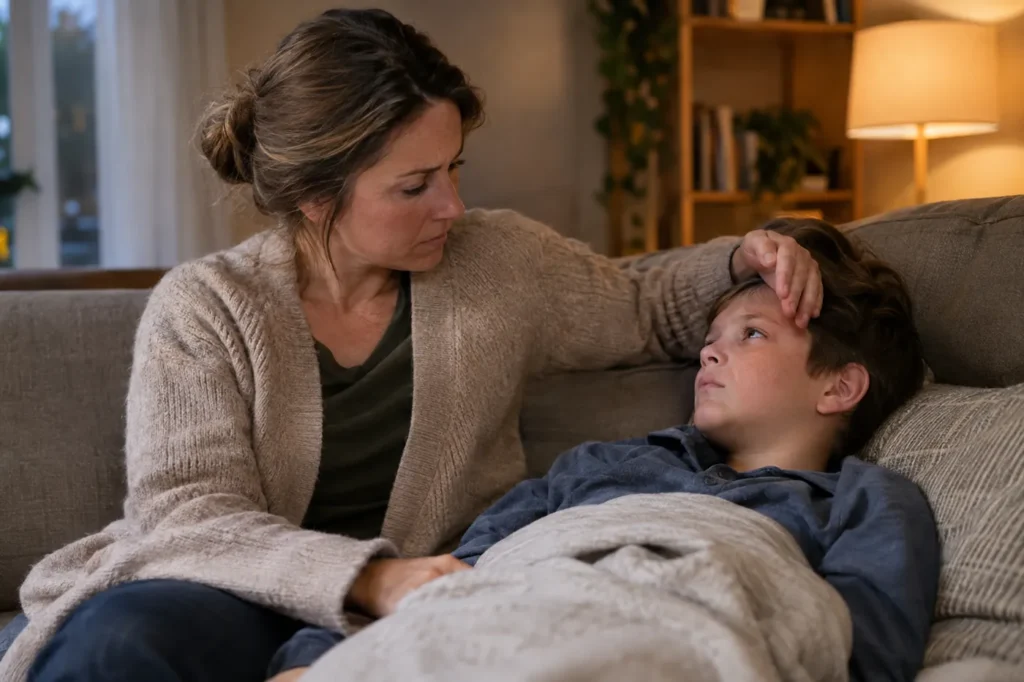
The younger the child, the lower the bar. A fever usually means 100.4 F or higher taken rectally, and any fever at that level in a baby under 3 months is urgent. MedlinePlus says to contact the provider right away for a baby 3 to 12 months old at 102.2 F or higher. The AAP’s Fever Without Fear guide says to call your child’s doctor when a fever lasts more than 24 hours in a child under 2, or more than 3 days in a child 2 or older.
Behavior counts as much as the number. The AAP says to call right away for a child with a fever who looks very ill, is unusually drowsy or very fussy, or has a stiff neck, a severe headache, an unexplained rash, or repeated vomiting or diarrhea.
Fever numbers to know, by age
- What counts as a fever
- 100.4 F or higher taken rectally, the most accurate reading for babies (AAP).
- 3 to 12 months
- 102.2 F or higher. Contact your child’s provider right away (MedlinePlus).
- Under 2 years
- A fever that lasts more than 24 hours. Call your child’s doctor (AAP).
- 2 years and older
- A fever that lasts more than 3 days, or rises above 104 F again and again (AAP).
- Adults
- A fever that stays at or keeps rising above 103 F, or lasts past 48 to 72 hours (MedlinePlus).
What causes a fever?
Most fevers come from infections, viral or bacterial, and almost any infection can cause one. MedlinePlus lists colds, flu, sore throats, ear and sinus infections, pneumonia, urinary tract infections, stomach bugs and skin infections, and Cleveland Clinic adds COVID-19. Some medicines, autoimmune conditions and certain cancers can also cause a fever, so one that lasts for weeks without a clear reason needs a doctor’s workup.
Teething doesn’t cause a true fever, according to the AAP. Heatstroke is a different problem: it comes from outside heat, not infection, and the AAP says it needs 911 or an emergency department right away.

Fever hanging on for days?
Walk in any day for an exam and rapid strep, flu or COVID testing, or save your spot online before you leave home.
How to bring a fever down at home
Fluids, rest and light clothing handle most fevers, and medicine is for comfort, not for reaching a normal number. MedlinePlus says a mild fever needs treatment only when you or your child is uncomfortable, vomiting, dehydrated or not sleeping well.
- Dress in one light layer. A light blanket is fine for chills, but don’t bundle up.
- Skip ice packs, cold baths and alcohol rubs. MedlinePlus says they can cause shivering, which raises body temperature.
- Offer water, ice pops or soup often. Babies should get breast milk or formula.
- Acetaminophen and ibuprofen both lower fever. For a child under 2, ask your pediatrician or pharmacist for the right dose (AAP), and for a baby 3 months or younger, call the provider before giving any medicine (MedlinePlus).
- No ibuprofen for babies 6 months or younger (MedlinePlus), and no aspirin for anyone under 17 because of Reye’s syndrome (Cleveland Clinic).
Taking an accurate temperature
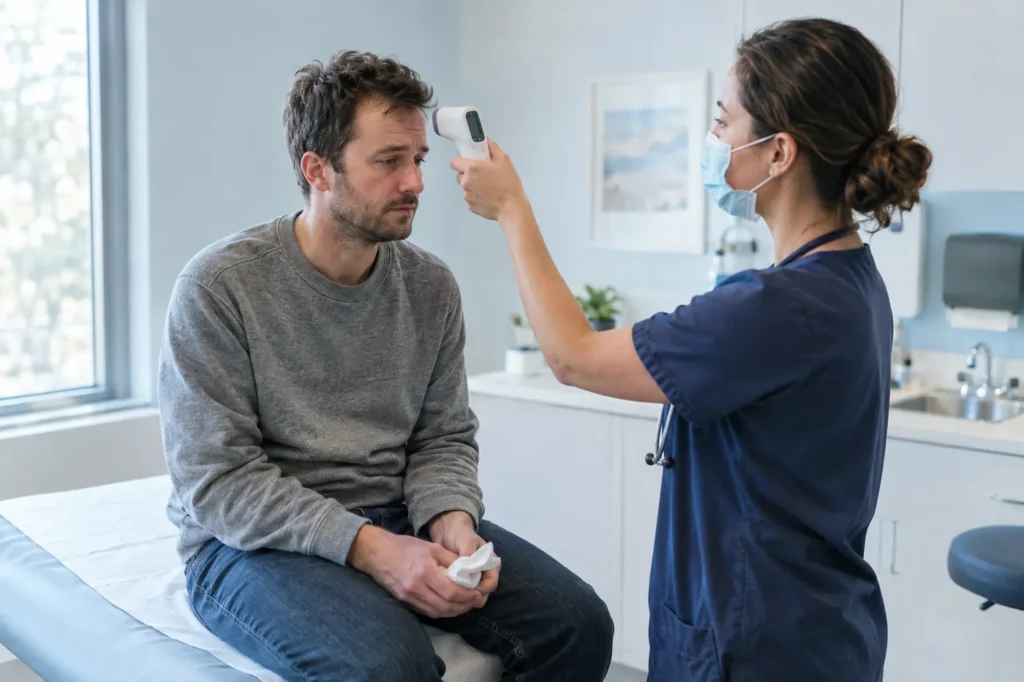
Use a digital thermometer. The AAP’s thermometer guide says rectal readings are the most accurate and the best choice for babies under 3 months. Forehead thermometers work at any age, oral ones from age 4 and ear ones from 6 months. Write down each reading, the time and any medicine doses to share at a visit.

Fever and dehydration signs to watch
A fever makes the body lose fluid faster, so watch drinking and peeing as closely as the thermometer. MedlinePlus counts thirst, a dry or sticky mouth, peeing less, darker yellow urine and headache among the signs of mild to moderate dehydration. In children, the AAP adds crying without tears and fewer wet diapers. Sip water or an electrolyte drink, or suck on ice chips.
Severe dehydration is an emergency. Watch for little or no urine, dizziness, a rapid heartbeat, quick breathing, sunken eyes or confusion. If someone who is dehydrated faints, turns confused, has a seizure or runs a fever above 102 F, MedlinePlus says to call 911.
For milder cases, the exam checks for signs such as low blood pressure and a fast heart rate, and a urine test can be done on site. We also offer IV hydration therapy. Whether IV fluids fit depends on your exam, so call (630) 914-5373 before you come if you’re hoping for them, and always call first for a child. Our page on nausea, vomiting and diarrhea covers stomach bugs.

Fever care at our Bolingbrook clinic
A provider examines you, looks for the source of the fever and decides which tests, if any, would help. Expect questions about when the fever started, the highest reading and what medicine you’ve taken. The exam can cover the skin, ears, throat, chest and belly, as MedlinePlus describes. We have no CT or MRI, but these tests are done here during the visit when they fit:
- Rapid strep test for a sore throat
- Rapid flu and COVID tests
- Urinalysis to look for a urinary tract infection
- Chest X-ray, available every day we are open, when pneumonia is a concern
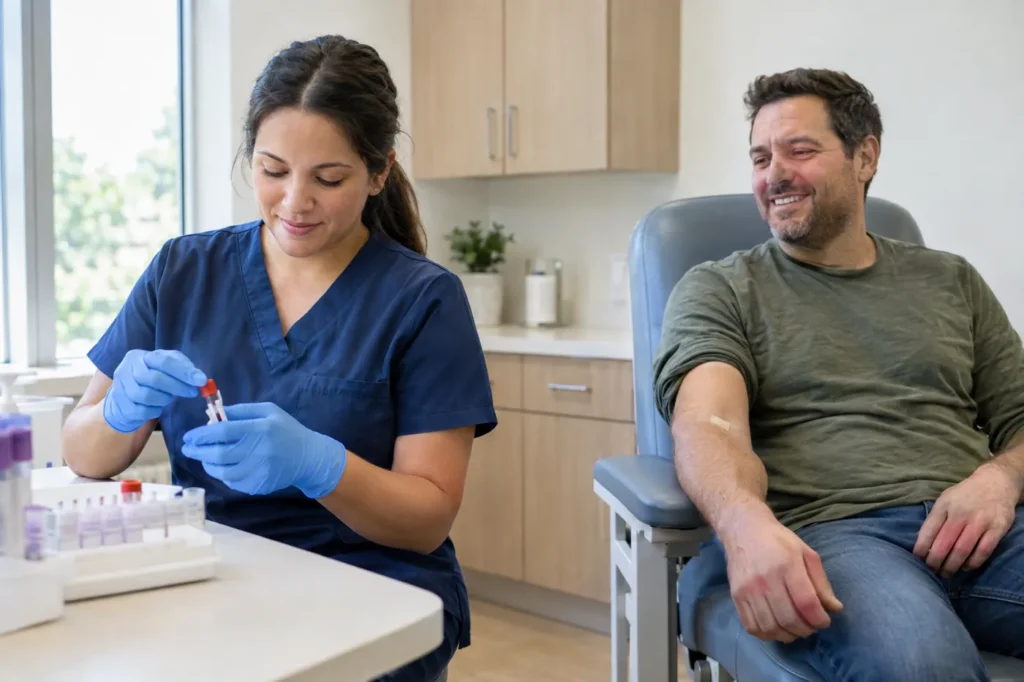
- Blood drawn on site for an outside lab, with results reported after you leave
What to bring to a fever visit
Bring a photo ID, your insurance card, a list of your medicines and your fever log. Our pediatric urgent care sees babies through the teen years, and the same visit steps apply to children.

Walk-in fever urgent care, 7 days a week
Walk-ins are welcome every day, and we’re open 8 AM to 8 PM. You can also book a time online. We don’t stay open overnight; in the evening, the booking page lists times for the next day. If a 911 sign appears overnight, don’t wait for morning. For fever with body aches and a cough, see flu testing and treatment.
We’re at 148 S Bolingbrook Dr. The U.S. Census Bureau places Bolingbrook almost entirely in Will County, with a sliver in DuPage. Romeoville is about 10 minutes away, and downtown Plainfield, which reaches into Kendall County, about 15.
We accept these plans: Aetna, Blue Cross Blue Shield of Illinois, Cigna, Humana, Medicare, UnitedHealthcare and Illinois Medicaid plans (HFS, Meridian, CountyCare, Molina, YouthCare). Call to confirm your specific plan. Paying on your own is an option too, so call for current self-pay pricing.
The Pioneer walk-in visit
How a visit works
- Step 1Walk in or save your spot
No appointment needed. You can also save your spot online before you leave home.
- Step 2Check in
Bring a photo ID, your insurance card and a list of the medicines you take.
- Step 3See a provider
Get examined, with X-ray and rapid tests on site when you need them.
- Step 4Leave with a plan
You go home with a care plan and clear next steps.
Why families in Bolingbrook choose Pioneer
Walk-in care that fits real life
Open 7 days a week
8 AM to 8 PM, weekends included, so a Saturday sore throat does not have to wait until Monday.
X-ray and tests on site
X-ray every day we are open, plus rapid strep, flu and COVID tests, urinalysis and EKG.
Care for kids and adults
From infants through the teen years, and adults of every age, in one clinic.
Insurance and self-pay
Aetna, BCBS of Illinois, Cigna, Humana, Medicare, Illinois Medicaid plans and UnitedHealthcare. Call to confirm your plan.
Questions and answers
Questions we hear often
Still not sure? Call (630) 914-5373 and we will help you decide.
Can I go to urgent care for a fever?
Yes. Urgent care, immediate care and walk-in clinics treat fevers in adults and children with no emergency signs. We can examine you and run rapid strep, flu or COVID tests, a urinalysis or a chest X-ray the same day. A baby under 3 months with a fever should go to an ER instead.
What temperature is too high for an adult?
Cleveland Clinic says adult fevers under 103 F usually aren’t dangerous. MedlinePlus advises calling a provider when a fever stays at or keeps rising above 103 F, or reaches 105 F and doesn’t come down with treatment. At any temperature, confusion, a stiff neck or trouble breathing means call 911.
Should I take my baby to urgent care for a fever?
It depends on age. A baby 3 months or younger with a rectal temperature of 100.4 F or higher should go to an emergency room after a call to the pediatrician. We see older babies and children for a fever that lasts, runs high or comes with ear pain or a sore throat.
Is a fever of 102 dangerous?
Usually not on its own. MedlinePlus says a cold can cause a fever of 102 F to 104 F without meaning something serious, and a child who is still playing, drinking and alert is less worrying. Babies 3 to 12 months need a call at 102.2 F. With dehydration, MedlinePlus lists a fever above 102 F as a reason to call 911.
Can you give IV fluids for fever and dehydration?
Sometimes. IV hydration therapy is one of our services, and whether it fits depends on your exam. Mild dehydration usually improves with sips of water or an electrolyte drink. If an adult can’t keep fluids down, call (630) 914-5373 before coming in to ask about IV fluids, and always call first for a child. Severe dehydration needs an ER or 911.
Can a vaccine cause a fever?
Yes. MedlinePlus says children and adults may run a low-grade fever for 1 or 2 days after some immunizations, and it lists a recent shot among reasons to contact your child’s provider. We don’t give childhood vaccinations, so check with the office that gave the shot.



Sources for this page
- Fever. MedlinePlus, National Library of Medicine.
- When your baby or infant has a fever. MedlinePlus, National Library of Medicine.
- Dehydration. MedlinePlus, National Library of Medicine.
- Fever Without Fear: Information for Parents. HealthyChildren.org, American Academy of Pediatrics.
- Fever and Your Baby. HealthyChildren.org, American Academy of Pediatrics.
- How to Take a Child’s Temperature. HealthyChildren.org, American Academy of Pediatrics.
- Fever. Cleveland Clinic.
- About Sepsis. Centers for Disease Control and Prevention.