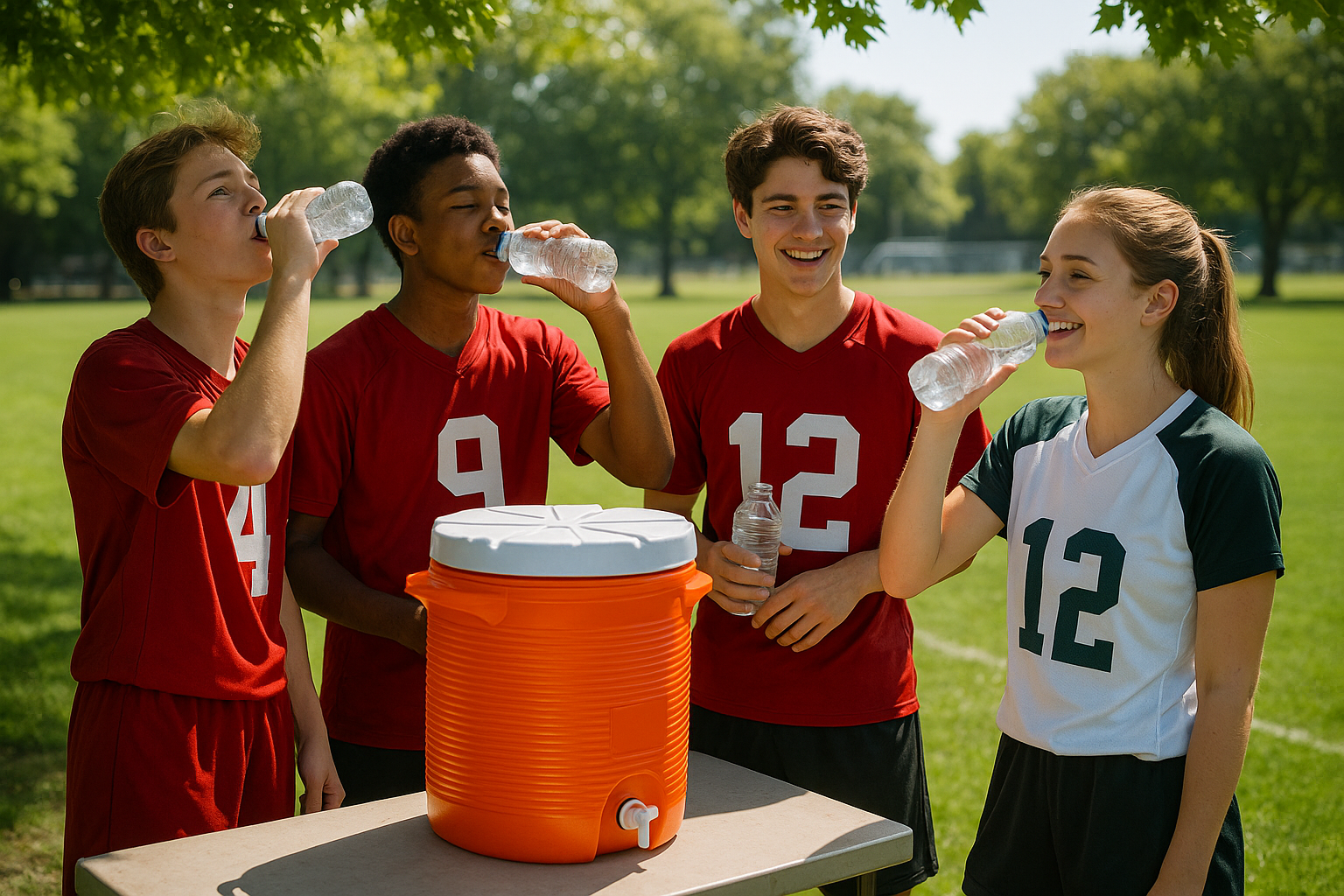
August in the western suburbs produces a predictable pattern: two-a-day football practices, marching band rehearsals on blacktop, roofing and landscaping crews working through the hottest part of the afternoon, and a steady trickle of people who pushed a little too far.
Most of them have heat exhaustion, which is genuinely unpleasant and usually resolves with the right care. A small number have heat stroke, which is a medical emergency that can cause permanent disability or death without emergency treatment. The two conditions share most of their early symptoms, which is exactly what makes them dangerous to sort out by feel.
There are two things to check that separate them, and neither requires a thermometer.
What is the difference between heat exhaustion and heat stroke?
Check mental status and skin. In heat exhaustion the person sweats heavily, has cool or clammy skin, and is mentally normal even if dizzy and miserable. In heat stroke the body’s cooling system has failed: skin can be hot and dry, and there is brain dysfunction, meaning confusion, agitation, slurred speech or loss of consciousness. Confusion, unconsciousness, or someone who has stopped sweating in the heat is a 911 emergency, not an urgent care visit.
We care for patients from Bolingbrook and the surrounding communities including Romeoville, Woodridge, Naperville, Plainfield, Downers Grove, Lockport, Lisle, Darien and Lemont. Our clinic is at 148 S Bolingbrook Dr, open 7 days a week from 8 AM to 8 PM, with walk-ins welcome. If you are dealing with heat illness after time outdoors, you can walk in or book a visit online.
The two-question test
If you remember nothing else from this article, remember these two questions. They are the ones a clinician runs first, and they are the ones that determine whether the next call is to us or to 911.
- 1Is the person thinking clearly?
Ask their name, where they are, and what happened. Confusion, agitation, aggression, slurred speech, or drowsiness they cannot be roused from all point toward heat stroke. In heat exhaustion, mental state is usually normal even when the person feels awful. - 2What does the skin feel like?
Heat exhaustion typically produces heavy, drenching sweat with cool, clammy skin. Heat stroke can leave skin hot and dry, because the sweating mechanism has failed. Someone who is very hot and has stopped sweating is a major warning sign. - 3If either answer is concerning, call 911
Do not wait to see whether rest and water help. Begin cooling immediately while help is on the way.
| Heat exhaustion | Heat stroke | |
|---|---|---|
| Mental status | Usually normal, may feel dizzy or faint | Altered: confusion, agitation, aggression, slurred speech, or unconsciousness |
| Skin | Heavy sweating, skin cool and clammy, often pale | Can be hot and dry; sweating may have stopped |
| Body temperature | Elevated but the body is still cooling itself | Rises rapidly; can reach 106 degrees Fahrenheit or higher within 10 to 15 minutes |
| Other signs | Muscle cramps, weakness, tiredness, headache, nausea or vomiting, fainting | Throbbing headache, nausea, rapid strong pulse, possible seizure or collapse |
| What it is | A serious warning that the body is struggling | A failure of the body’s temperature control. A medical emergency |
| What to do | Move to a cool place, give fluids, cool actively. Most improve within about 30 minutes with prompt treatment | Call 911 immediately and start cooling. Do not delay to test whether rest helps |
Heat stroke can cause permanent disability or death without emergency treatment. The presence of altered mental status is the single most important finding.
Why the temperature spike is so fast
The number that surprises people is the speed. In heat stroke, body temperature can rise to 106 degrees Fahrenheit or higher within 10 to 15 minutes.
That timescale explains why the advice is to call 911 rather than drive to a clinic when mental status is off. The window in which cooling prevents organ damage is measured in minutes, not in the time it takes to find parking. It also explains why “they seemed fine ten minutes ago” is not reassuring in this specific situation. In heat stroke, ten minutes is enough time for the picture to change completely.
The spectrum before heat stroke
Heat illness is not a switch. It is a progression, and the earlier stages are the ones where intervention is easy and effective.
- Heat rash shows up as clusters of small blisters or red bumps, usually in skin folds or where clothing traps sweat. It is a signal that skin has been damp and hot for too long.
- Heat cramps are painful muscle spasms, often in the legs or abdomen, that come with heavy sweating during exertion. They reflect fluid and electrolyte loss.
- Heat exhaustion brings heavy sweating, cool clammy skin, weakness, dizziness, headache, nausea, and sometimes fainting.
- Heat stroke is the failure point, marked by altered mental status and a body that has stopped cooling itself.
The useful thing about knowing the ladder is that you can act at the bottom of it. Cramps in a two-a-day practice are not something to push through. They are information.
What to do in the first ten minutes
For heat exhaustion, the goal is straightforward: get the person out of the heat and cool them down. CDC guidance for heat exhaustion is to move to a cool place, give water or a sports drink, and use fans, cool cloths or shade to bring body temperature down. Most people improve within about 30 minutes when treated quickly.
For suspected heat stroke, call 911 first, then cool aggressively while waiting. Move the person into shade or air conditioning, remove excess clothing, and apply cool water or cold cloths to the skin, focusing on the neck, armpits and groin where large blood vessels run close to the surface.
Two things not to do. Do not give fluids by mouth to someone who is confused or not fully alert, because of the risk of choking. And do not assume that because someone stopped sweating they must be cooling off. In this context, the absence of sweat is the alarm, not the all-clear.
Who is at higher risk
Heat illness is not distributed evenly, and knowing where you sit changes how cautious you should be.
- Outdoor workers in construction, roofing, landscaping and warehouse settings, particularly during the first few days of a heat wave before the body has adapted.
- Young athletes in preseason practice, especially in equipment-heavy sports where gear limits heat loss.
- Older adults, who sense thirst less reliably and may take medications that affect sweating or fluid balance.
- Young children, who heat up faster relative to body size and depend on adults to manage their exposure.
- People with chronic conditions such as heart disease, diabetes or kidney disease, and anyone on diuretics or certain psychiatric or blood pressure medications.
- Anyone who is unacclimatized. The first hot days of the season and the first days back at an outdoor job carry disproportionate risk.
When urgent care is the right call
Being clear about the dividing line, because it is the whole point of this article.
Call 911 for confusion, agitation, slurred speech, seizure, loss of consciousness, or someone very hot who has stopped sweating. Heat stroke needs emergency treatment and often needs it in transit.
Urgent care is appropriate for heat exhaustion that is not improving with cooling and fluids, for repeated vomiting that prevents rehydration, for significant cramping and weakness after a hot shift or practice, and for the common situation where someone feels genuinely unwell after heat exposure and it is not clear how dehydrated they are.
At our Bolingbrook clinic we can assess how dehydrated someone actually is, draw blood to check electrolytes and kidney function when that is warranted (the sample goes to an outside lab), and provide fluids. Because we can examine you, test your urine and start treatment in the same visit, we can usually answer the question that matters, whether this is simple dehydration or something that needs a higher level of care.
We will also tell you plainly when the answer is the emergency room. Anyone arriving with altered mental status belongs in an emergency department, and we will arrange that rather than work them up here.
Preventing the visit entirely
None of this is complicated, and in August it is worth being deliberate about.
- Drink before you are thirsty. Thirst lags behind fluid loss, particularly in older adults.
- Build up gradually. Acclimatization takes days, so the first hot practice or first hot shift should not be the hardest one.
- Schedule the heaviest work outside the hottest part of the afternoon where you have any control over it.
- Take breaks in shade or air conditioning before you feel you need them.
- Wear light, loose, breathable clothing, and use the cooling breaks that equipment-heavy sports build in.
- Watch each other. The person with early heat stroke is, by definition, the person least able to assess themselves.
That last point carries the most weight. Altered thinking is the defining feature of heat stroke, which means the affected person cannot be relied on to recognize it. Someone else has to notice. In a practice, a crew or a family, that is a job worth assigning explicitly on a hot day.
Hydration: more nuanced than drink more water
Fluid replacement is the obvious answer to heat stress, and for most people on most days plain water is the right one. There are two situations where the advice needs refining.
The first is prolonged, heavy sweating. Someone working an eight-hour outdoor shift or playing through a tournament is losing sodium as well as water. Replacing only water over many hours, in high volume, can dilute blood sodium, which produces its own set of problems including headache, nausea, confusion and, in severe cases, seizures. Confusingly, several of those overlap with heat illness itself. This is the reason sports drinks and electrolyte solutions exist, and the reason they are more useful during long exertion than during a normal day.
The second is the opposite error. People sometimes try to correct heat stress by drinking an enormous volume quickly. Steady intake across the day does far more than a large volume consumed after the fact.
A practical rule that works for most people: drink on a schedule rather than by thirst during heavy heat exposure, use an electrolyte-containing drink when sweating heavily for more than an hour or two, and treat dark urine and a dry mouth as signals you are already behind rather than as the point at which to start.
Medications and conditions that raise your risk
Two people can do the same work in the same heat and have very different physiology. Some of the difference is fitness and acclimatization. A significant part is medication.
- Diuretics, prescribed for blood pressure and heart failure, increase fluid loss.
- Beta blockers can blunt the cardiovascular response that helps shed heat.
- Anticholinergic medications, including some antihistamines, bladder medications and tricyclic antidepressants, can reduce sweating, which is the body’s main cooling mechanism.
- Some antipsychotic medications can interfere with the brain’s temperature regulation.
- Stimulants, including some ADHD medications and recreational stimulants, raise heat production.
- Alcohol increases fluid loss and impairs judgment about when to stop.
Chronic conditions matter for the same reason. Heart disease limits the circulatory response to heat. Diabetes can affect both sweating and the perception of early warning symptoms. Kidney disease narrows the margin for fluid and electrolyte swings.
None of this is a reason to stop a prescribed medication, and you should not. It is a reason to be more conservative about heat exposure, more deliberate about breaks and fluids, and quicker to get evaluated if you feel unwell. If you are unsure whether something you take affects heat tolerance, that is a good question for a visit or a call to your pharmacist.
Acclimatization: the first days are the dangerous ones
The body adapts to heat, and the adaptation is real and measurable. Over roughly one to two weeks of repeated exposure, people begin sweating earlier, sweating more efficiently, and losing less sodium in sweat.
The implication is the part that gets missed. Risk is concentrated at the beginning. The first hot practice of preseason, the first day back on an outdoor job after a vacation, and the first day of an early-season heat wave are disproportionately when heat illness happens, because the physiology has not caught up to the conditions.
Well-designed programs handle this by ramping intensity and equipment over the opening days rather than starting at full load. If your child’s team or your employer does that, it is not excessive caution. It is the single most effective structural protection against heat illness there is.
Children, cars and the fastest-moving risk
One specific hazard deserves its own paragraph because the timescale is unlike anything else in this article. A closed vehicle in summer heats far faster than most people intuitively expect, and small children heat up faster relative to their body size than adults do.
Never leave a child in a parked car, not for a quick errand, not with the windows cracked, not on a day that feels merely warm. If you see a child alone in a vehicle and they appear distressed, call 911. This is one of the few situations in this article where there is no judgment call to make.
Coming back after a heat illness
People who have had a significant heat illness are at higher risk of another one, at least for a period afterward, and returning straight to full intensity is a common way to end up back where you started.
For mild heat exhaustion that resolved quickly with rest and fluids, a sensible approach is a day of easy activity in cooler conditions before returning to normal load, with attention to hydration in the days after. For anything more significant, particularly anything that required medical evaluation, the return should be guided by a clinician rather than by how the person feels, because feeling recovered arrives before physiological recovery is complete.
If someone has had heat stroke, return to sport or heavy outdoor work is a medical decision, not a personal one. That is a conversation to have with a provider who knows what happened.
This article is for general education and is not medical advice. It does not replace an evaluation by a licensed clinician. If you think you are having a medical emergency, call 911 or go to the nearest emergency room.
Frequently asked questions
What is the one sign that means heat stroke rather than heat exhaustion?
Altered mental status. Confusion, agitation, aggression, slurred speech or unconsciousness points to heat stroke, which is a 911 emergency. Hot dry skin, or someone very hot who has stopped sweating, is another major warning sign.
How fast can heat stroke develop?
Very fast. According to CDC, in heat stroke body temperature can rise to 106 degrees Fahrenheit or higher within 10 to 15 minutes, which is why you should call 911 rather than wait to see whether rest and water help.
Should I give water to someone with suspected heat stroke?
Do not give fluids by mouth to anyone who is confused or not fully alert, because of the choking risk. Call 911 and begin cooling them externally with cool water, cold cloths, shade or air conditioning.
How long does heat exhaustion take to improve?
Most people with heat exhaustion get better within about 30 minutes if they are treated quickly with cooling and fluids. If someone is not improving, is vomiting repeatedly, or seems to be getting worse, they should be evaluated.
Can urgent care treat heat exhaustion?
Yes. We can assess dehydration, check electrolytes and kidney function with on-site labs when appropriate, and provide fluids. Anyone with altered mental status needs an emergency department instead, and we will arrange that.
Sources
- CDC / NIOSH: Heat-related illnesses
- CDC: About Heat and Your Health
- American Academy of Pediatrics: HealthyChildren.org
Guidance from public health agencies changes. Dates and figures above reflect the sources as published at the time of writing. Always confirm current requirements with the issuing agency or your school district.
Need care today in Bolingbrook?
Walk in or book online. Open 7 days a week, 8 AM to 8 PM, with X-ray and rapid tests on site.