
Walk-in care · Bolingbrook, IL
Confidential STD Testing in Bolingbrook, IL
Pioneer Physicians Urgent Care offers confidential STD testing in Bolingbrook, IL, at 148 S Bolingbrook Dr. We’re open every day from 8 AM to 8 PM. Walk in with no appointment, or save your spot online. We test for common STIs, some results are ready the same day, and self-pay is available if you prefer not to use insurance.
- Open 7 days, 8 AM to 8 PM
- Walk-ins welcome
- X-ray and rapid tests on site
- Kids and adults
- Medicare and Medicaid plans accepted

Can I walk in for STD testing in Bolingbrook?
Yes. Walk-in STD testing is available seven days a week, including Saturdays and Sundays, and you do not need an appointment. We are open 8 AM to 8 PM.
If you would rather pick a time, save your spot online. In the evening, the booking page shows times for the next day, so a late decision can still turn into a planned visit. We are not open 24 hours.
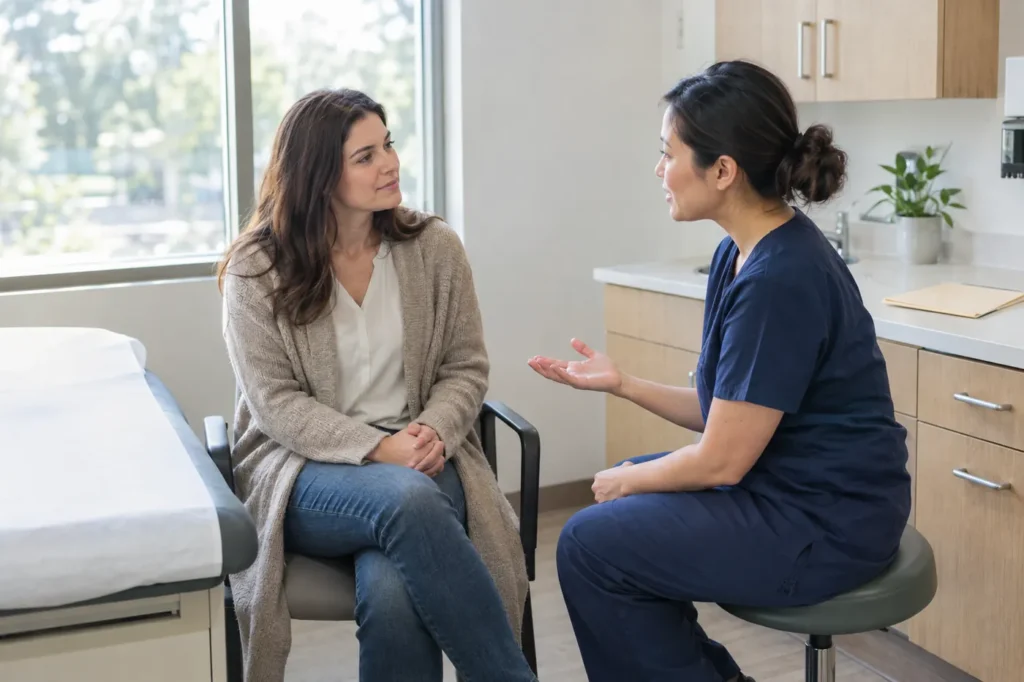
Testing happens during a regular visit at our walk-in urgent care in Bolingbrook. You see a provider, talk through what you want checked, and give your samples before you leave.

Which STI tests can I get?
We test for common STIs. Which tests you have depends on your health history, any symptoms and how long it has been since a possible exposure, and your provider helps you choose. If you are looking for one specific test, call (630) 914-5373 to ask about it before you come in.
Different infections need different samples. In general, MedlinePlus guidance on STI testing describes three kinds:
- Urine sample: used to check for chlamydia and trichomoniasis, and sometimes gonorrhea.
- Swab sample: taken from the area where an infection may be, and used for infections such as chlamydia, gonorrhea and herpes.
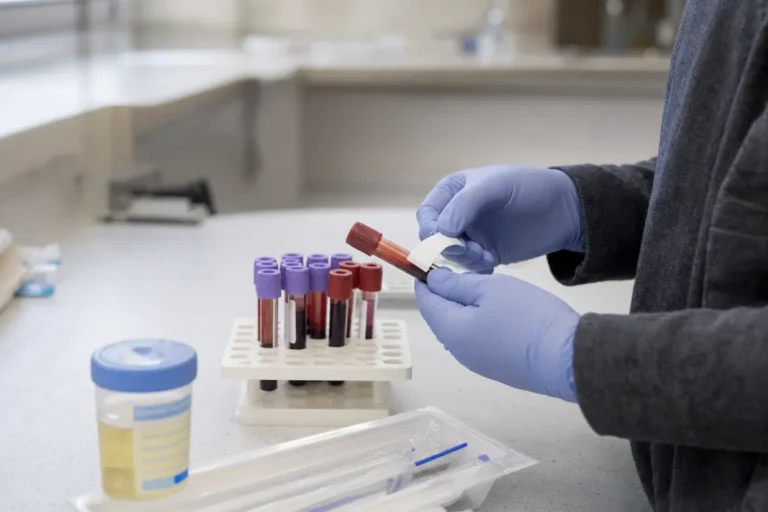
- Blood sample: used for syphilis and HIV, and sometimes herpes. When your tests need blood, we draw it here and send it to an outside lab.
Why tests are often done together
MedlinePlus notes that people often have more than one STI at the same time. Many people who have chlamydia also have gonorrhea, which is why a chlamydia test is often done alongside other STI tests. Ask which tests you are having before you leave, so you know which results to watch for.
How an STD testing visit works
- 1Walk in or save your spot
Walk in any day with no appointment, or book a time online.
- 2Check in
Show a photo ID and your insurance card, or choose self-pay.
- 3Talk privately
A provider reviews your history and any symptoms and helps pick the tests.
- 4Give samples
Urine, a swab or a small blood draw. Your tests decide which.
- 5Get results
Some are ready the same day. Others come back from an outside lab.
Who should get tested, and how often
Anyone with symptoms should be tested, and many people without symptoms should be screened on a regular schedule. The CDC points out that STIs often cause no symptoms, so you may not know you have one. Testing is the only way to find out for sure.
The CDC guidance on getting tested and MedlinePlus include these recommendations:
- Everyone ages 13 to 64 should be tested for HIV at least once.
- All sexually active women younger than 25 should be tested for chlamydia and gonorrhea every year.
- Some women 25 and older should also be tested every year, for example those with a new partner, more than one partner, or a partner who has an STI.
- Sexually active gay and bisexual men, and other men who have sex with men, should be tested for syphilis, chlamydia, gonorrhea and HIV at least once a year.
- After treatment for chlamydia, MedlinePlus advises a repeat test three months later, because repeat infections are common.
Applying the guidelines to you
If a partner tells you they have an STI, get tested even if you feel fine. MedlinePlus advises anyone diagnosed with an STI to tell their partners so they can be tested and treated too.
These are general guidelines for the public. Your provider can help you apply them to your own history, decide which tests make sense at this visit, and suggest when to come back for the next screening.
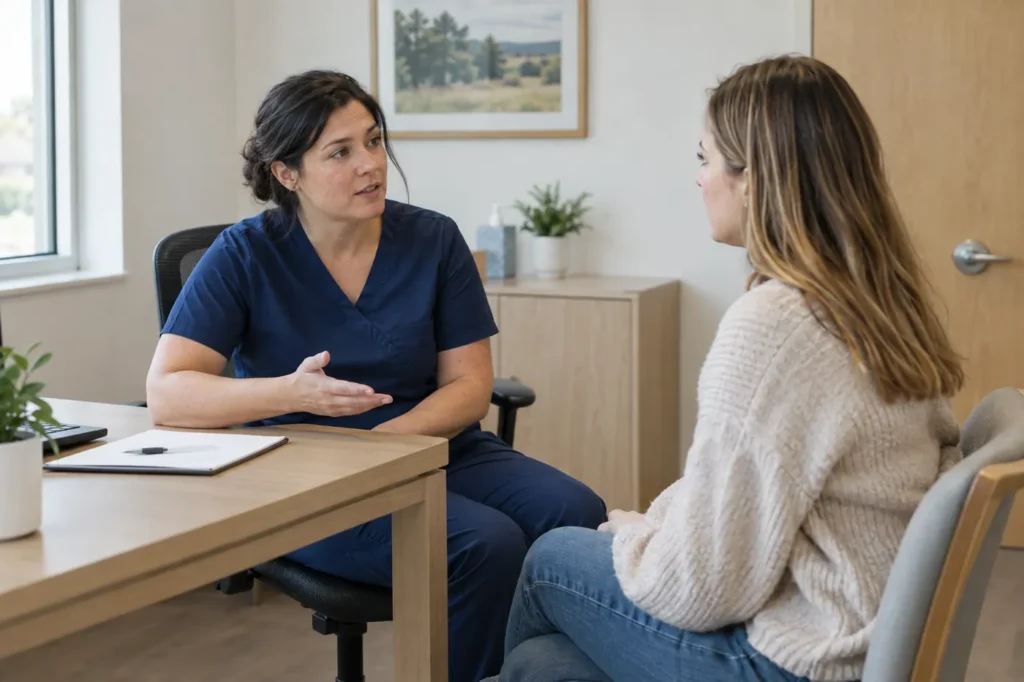
What happens at an STD testing visit
A visit starts with a private conversation and ends with collecting the samples your tests need. At check-in, show a photo ID and your insurance card if you plan to use insurance.
A provider then asks about your health history, any symptoms, when they started and when you were last tested. These are routine medical questions, and there is no need to feel embarrassed. Clear answers help the provider pick the right tests.
Next you give the samples. That may mean a urine sample in a cup, a swab, or a small blood draw from a vein in your arm. MedlinePlus says a blood draw carries very little risk beyond slight pain or bruising, and urine and swab tests have no known risks.
Bring these to the visit:
- A photo ID
- Your insurance card, if you plan to use insurance
- A list of your medicines, including over-the-counter products, and any allergies
- The date of your last STI test and its results, if you know them
- A note of when any symptoms started
How to prepare
Most STD tests need little preparation. MedlinePlus says no special preparation is needed for a blood test. For a first-catch urine test for chlamydia, it advises not urinating for two hours beforehand so the result is accurate, and it notes you may need to skip vaginal douches and creams for 24 hours before the test. Do not stop any medicine on your own before a test. Ask your provider first.
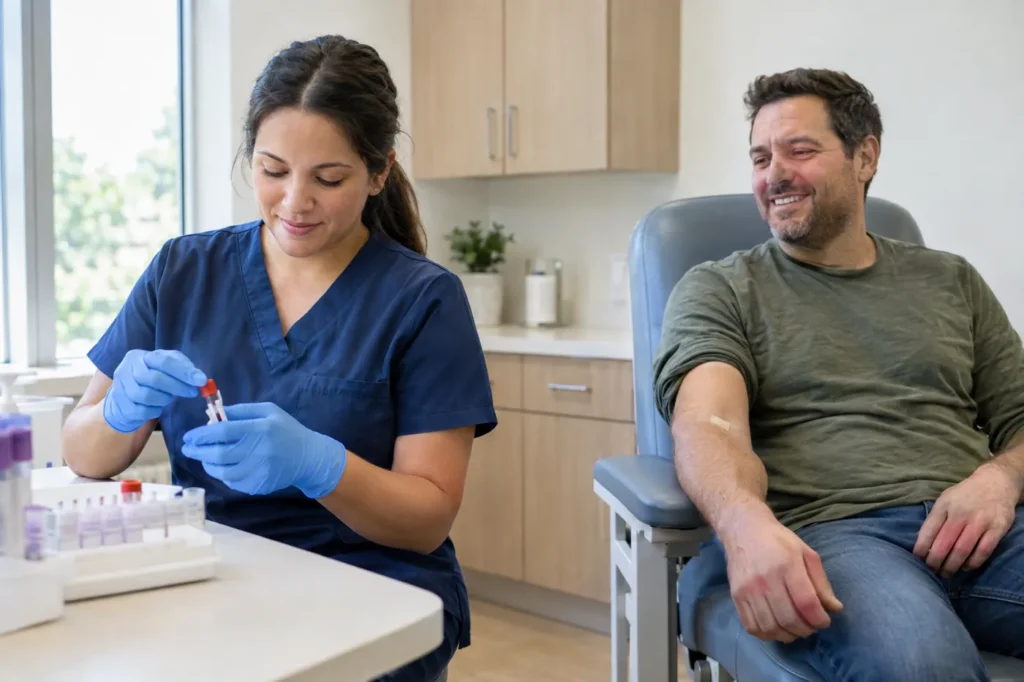
Walk in for STD testing today
Walk in any day for a private visit, or save your spot online if you would rather pick a time.
How soon are STD test results back?
Some results are ready the same day, and others are sent to an outside lab and take longer. Timing depends on which tests you have. Before you leave, ask which results to expect today and how the rest will reach you.
Timing after a possible exposure also matters, especially for HIV. HIV.gov explains that no HIV test can detect the virus immediately after exposure. A lab test on blood from a vein can usually detect HIV 18 to 45 days after exposure, and for some tests the window can be as long as 90 days. A negative result soon after a possible exposure may need a repeat test later, and the provider can tell you when.
If a result is positive, ask what it means and what the next steps for treatment are. MedlinePlus notes that all STIs can be treated and some can be cured, and it advises taking any medicine exactly as prescribed.
Is STD testing confidential?
Yes. Your visit and your results are part of your confidential medical record, and HIPAA, the federal health privacy law, protects that information.
You also have a say in how we reach you. Under the HIPAA Privacy Rule, a health care provider must accommodate reasonable requests to send your health information by another method or to another place, such as a different phone number or address (45 CFR 164.522). Tell us at check-in how you want to be contacted about results.
If you are covered on a parent’s or spouse’s insurance plan and have questions about what the plan mails home, call your plan before the visit, or ask us about self-pay visits.

What STD testing costs with insurance or self-pay
The cost depends on your insurance plan and which tests you need. Self-pay is available if you would rather not use insurance, and the self-pay cost is the visit plus any tests the provider orders. Call (630) 914-5373 for current self-pay pricing.
We accept Aetna, Cigna, Medicare, Blue Cross Blue Shield of Illinois, UnitedHealthcare, Humana, and Illinois Medicaid plans (HFS, Meridian, CountyCare, Molina and YouthCare). Call to confirm your specific plan before you come in.
Many plans treat certain screenings as preventive care. HealthCare.gov lists HIV screening, and syphilis screening for adults at higher risk, among the services that all Marketplace plans and many other plans must cover without a copay or coinsurance when you see an in-network provider. It also says $0 cost is not guaranteed in all cases, so check with your plan.
Getting here from nearby towns
Our clinic is about 10 minutes by car from Romeoville and 11 from Woodridge. Lemont, Darien and Lisle are about 14 minutes away, Plainfield about 15, Downers Grove about 16, Lockport about 17 and downtown Naperville about 18. The Lemont and Downers Grove pages listed below cover STD testing and the drive from those two towns.

The Pioneer walk-in visit
How a visit works
- Step 1Walk in or save your spot
No appointment needed. You can also save your spot online before you leave home.
- Step 2Check in
Bring a photo ID, your insurance card and a list of the medicines you take.
- Step 3See a provider
Get examined, with X-ray and rapid tests on site when you need them.
- Step 4Leave with a plan
You go home with a care plan and clear next steps.
Why families in Bolingbrook choose Pioneer
Walk-in care that fits real life
Open 7 days a week
8 AM to 8 PM, weekends included, so a Saturday sore throat does not have to wait until Monday.
X-ray and tests on site
X-ray every day we are open, plus rapid strep, flu and COVID tests, urinalysis and EKG.
Care for kids and adults
From infants through the teen years, and adults of every age, in one clinic.
Insurance and self-pay
Aetna, BCBS of Illinois, Cigna, Humana, Medicare, Illinois Medicaid plans and UnitedHealthcare. Call to confirm your plan.
Questions and answers
Questions we hear often
Still not sure? Call (630) 914-5373 and we will help you decide.
Do I need an appointment for STD testing?
No. Walk-ins are welcome seven days a week, and we are open 8 AM to 8 PM, weekends included. If you prefer a set time, you can save your spot online. After 8 PM, the booking page shows times for the next day, so you can plan a visit even when we are closed.
Which STD tests can I get in Bolingbrook?
We test for common STIs. Your provider recommends tests based on your history, any symptoms and the timing of a possible exposure. Depending on the test, you give a urine sample, a swab or a small blood draw, and blood goes to an outside lab. If you need one specific test, call (630) 914-5373 to ask before you come in.
How long do STD test results take?
Some results are ready the same day. Others go to an outside lab, and the wait depends on the test. Before you leave, ask which results you will have today and how you will get the rest. If a test was done soon after a possible exposure, the provider may suggest repeating it later.
Is STD testing free?
Cost depends on your insurance. Many plans cover certain screenings as preventive care, but coverage varies, so check with your plan before the visit. Self-pay is available for people who prefer not to use insurance. The self-pay cost is the visit plus the tests you need. Call (630) 914-5373 for current self-pay pricing.
Should I get tested if I have no symptoms?
Often, yes. The CDC notes that STIs often cause no symptoms, so you may not know you have one. It recommends at least one HIV test for everyone ages 13 to 64, and yearly chlamydia and gonorrhea testing for all sexually active women under 25. Your provider can help you decide what fits your history.
How soon after a possible exposure should I get tested?
It depends on the infection and the test. HIV.gov explains that no HIV test can detect the virus immediately after exposure, and a lab test on blood from a vein usually detects it 18 to 45 days later. If an early test is negative, you may need a repeat test after the window period. The provider can help time your tests.
Will my STD test results be kept private?
Yes. Your results are part of your confidential medical record, protected by HIPAA, the federal health privacy law. You can ask us to contact you by a specific phone number or address. If you are on a family member’s insurance plan and have questions about what the plan mails, call your plan or ask about self-pay.
Are you an STD clinic?
We are a walk-in urgent care clinic, not a dedicated STD clinic, and STD testing is one of our regular services. You can come in for testing alone, with no other health concern. The visit goes in your confidential medical record like any other visit. If you also have symptoms such as burning when you urinate, the provider can check those at the same visit.




Sources for this page
- Getting Tested for STIs. Centers for Disease Control and Prevention.
- Sexually Transmitted Infection (STI) Tests. MedlinePlus, National Library of Medicine.
- Chlamydia Test. MedlinePlus, National Library of Medicine.
- Sexually Transmitted Infections. MedlinePlus, National Library of Medicine.
- HIV Testing Overview. HIV.gov, U.S. Department of Health and Human Services.
- 45 CFR 164.522, Rights to request privacy protection for protected health information. Electronic Code of Federal Regulations (eCFR).
- Preventive care benefits for adults. HealthCare.gov, Centers for Medicare and Medicaid Services.
- Abdominal pain. MedlinePlus Medical Encyclopedia, National Library of Medicine.