
Walk-in care · Bolingbrook, IL
Asthma Treatment in Bolingbrook, IL
Pioneer Physicians Urgent Care offers asthma treatment in Bolingbrook, IL, for adults and children with mild to moderate flare-ups. We’re open every day from 8 AM to 8 PM, walk-ins are welcome, and you can also save your spot online. If you are struggling to breathe, your lips look bluish or your rescue inhaler is not helping, call 911.
- Open 7 days, 8 AM to 8 PM
- Walk-ins welcome
- X-ray and rapid tests on site
- Kids and adults
- Medicare and Medicaid plans accepted

Can I get asthma treatment at urgent care in Bolingbrook?
Yes, if the asthma attack is mild to moderate. An attack, or flare-up, happens when the airways swell and tighten so less air gets through. NHLBI notes that attacks can build slowly or come on fast, and that some people can manage a flare with their reliever inhaler alone. A same-day visit makes sense when a flare keeps coming back or you need your reliever more often than usual. If your medicine is not easing an attack, call 911 instead.
We see walk-in asthma patients seven days a week at 148 S Bolingbrook Dr, or you can save your spot online if you would rather plan ahead. We are not open overnight, so if breathing gets much harder after we close, call 911 or go to an emergency room.

Signs your asthma is flaring
A flare usually looks like your normal asthma, only stronger and harder to settle. NHLBI lists these as the main symptoms of asthma:
- Wheezing, a whistling sound when you breathe out
- Coughing, especially at night or early in the morning
- Shortness of breath
- A tight chest, which some people say feels like someone is sitting on it
Signs your asthma is getting worse
Watch the pattern as well as the symptoms. NHLBI says asthma may be getting worse when symptoms show up more often, you need your reliever medicine more than usual, coughing wakes you at night, or asthma keeps you from normal activity or exercise. Any of these is a reason to come in before a small flare becomes a big one.

What we can help with today
- Breathing
- Wheezing, coughing or a tight chest, but you can breathe at rest
- Talking
- Some shortness of breath when you talk
- Rescue inhaler
- Helps, but you need it more often than usual
- Lips and face
- Usual color
- Alertness
- Alert and acting like yourself
- Peak flow, if you use a meter
- 50 to 80 percent of your personal best
What happens at an asthma visit
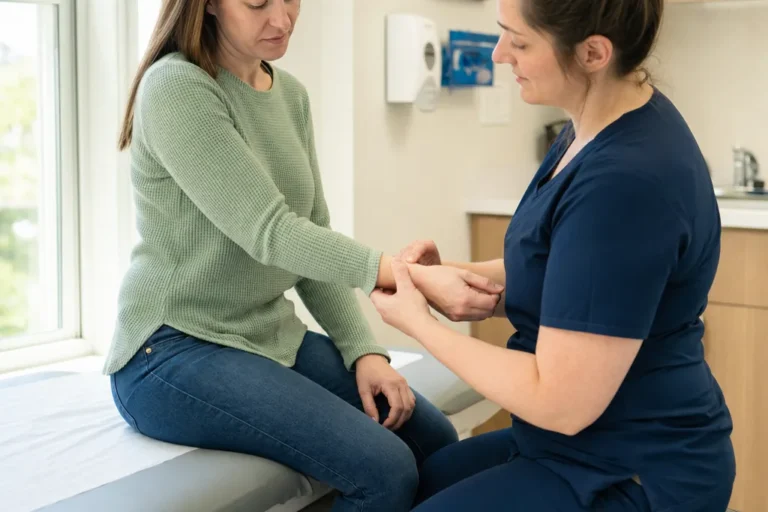
A provider asks about the flare, checks your breathing and then talks through treatment with you. Expect questions about what set it off, which medicines you took today, past attacks and how often you reach for your rescue inhaler. As MedlinePlus describes, a stethoscope lets the provider listen for wheezing and other asthma sounds.
Treatment depends on what the exam shows and on what you already use at home. MedlinePlus describes two kinds of asthma medicine: quick-relief medicines used during a flare, and long-term control medicines taken every day to help prevent attacks. Before you leave, ask what to watch for over the next few days and what should send you to an emergency room.
Tests we can run on site
A rapid flu or COVID test, done during the visit, can show whether one of those viruses set things off. X-ray is available every day we are open, although MedlinePlus notes that asthma attacks often happen with a completely normal chest X-ray, so its main job is to check for other conditions. If the provider wants to check your heart as well, an EKG can record its electrical activity during the visit.
What we do not do
Our clinic has no CT or MRI scanner, does not stay open overnight and does not give childhood vaccinations. A severe attack, or one your own medicine is not easing, belongs in a hospital emergency department.
Can you refill my inhaler?
Come in and tell us you have run out, and a provider will review your asthma and decide what you need after the exam. We cannot promise a particular prescription before you are seen, because the right choice depends on how your breathing is doing that day.
Running low fast is worth a conversation. MedlinePlus says to tell your provider if you use quick-relief medicine twice a week or more, since that can mean your asthma is not under control. NHLBI adds that people who go through more than one reliever canister a month should seek care right away when symptoms start. For follow-up between flares, we also offer primary care.
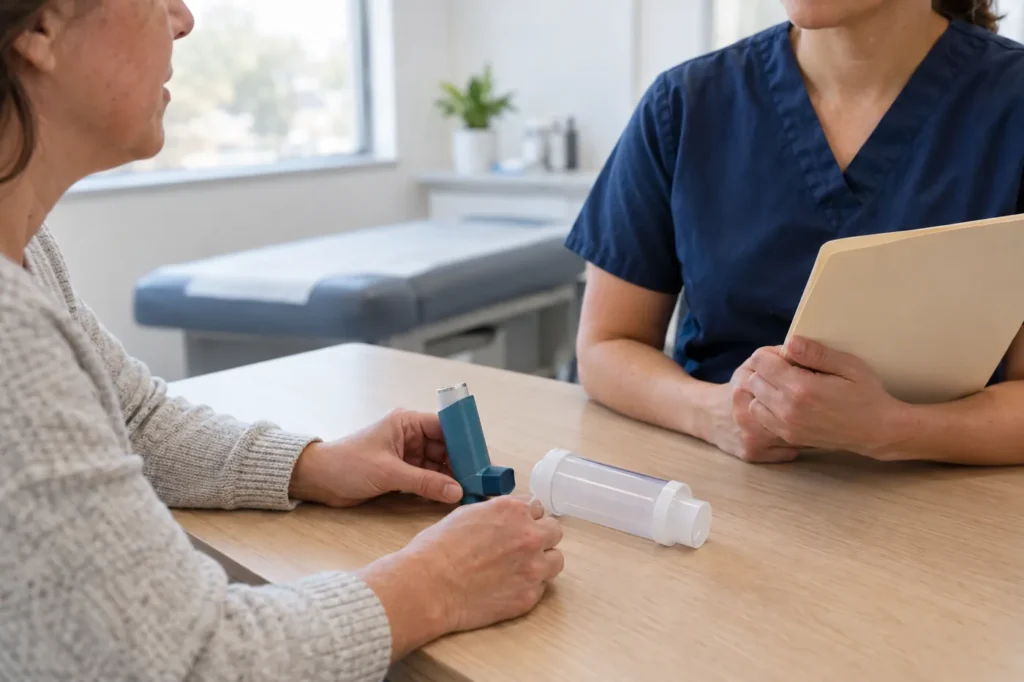
Breathing harder than usual today?
Walk in any day with no appointment, or save your spot online, and bring every inhaler you use.
Asthma care for children and teens
We treat asthma flares in children as part of our pediatric urgent care, which sees patients from infancy through the teen years. Asthma can look different in kids. NHLBI says children may cough in their sleep, skip active play to avoid symptoms, tire quickly or ask to be carried on walks. MedlinePlus adds that a night cough may be the only symptom, and that the skin of the chest and neck may pull inward when a child is working hard to breathe.
Under the Illinois School Code, 105 ILCS 5/22-30, public, charter and private schools must let a student carry and use prescribed quick-relief asthma medicine once parents give written permission and the prescription label. Schools must also ask families each year for the student’s asthma action plan, a written plan made with the child’s medical provider.
For a child’s yearly flu shot, which CDC calls especially important for people with asthma, check with your child’s pediatrician or family doctor, or with the Will County or DuPage County health department. We do not give childhood vaccinations.

Common asthma triggers and flu season
Triggers are the things that set off or worsen asthma symptoms, and they differ from one person to the next. NHLBI names these common triggers:
- Dust mites, mold and pet dander indoors
- Pollen and mold outdoors
- Colds, flu and COVID-19
- Exercise and physical activity
- Stress and strong emotions
- Poor air quality or very cold air
- Certain medicines, such as aspirin
Why flu season matters with asthma
Viruses deserve extra attention in fall and winter. According to CDC, flu can trigger asthma attacks, and people with asthma face a higher risk of serious flu complications. CDC also says people with asthma generally should not get the nasal spray flu vaccine. Adults can walk in for a flu shot here. If your symptoms always seem to follow pollen season or a visit with a friend’s cat, allergy testing can help show what you react to.

What to bring to your visit
Bring every inhaler you use, a list of your medicines and your action plan if you have one. Having the inhaler with you lets you ask the provider to watch how you use it. MedlinePlus points out that when an inhaler is used the wrong way, less medicine gets into the lungs, and it recommends a spacer for children who use an inhaler.
Here is what to pack:
- Every inhaler you use, plus your spacer if you have one
- A list of your other medicines, including over-the-counter ones and supplements
- Your written asthma action plan, if you have one
- Recent peak flow numbers, if you use a peak flow meter
- Your insurance card and a photo ID
- For a child, any notes or forms from the school nurse
Insurance and self-pay for asthma care
An asthma visit can go through your insurance, or you can pay for it yourself. We take Aetna, Cigna, Medicare, Blue Cross Blue Shield of Illinois, UnitedHealthcare, Humana and Illinois Medicaid plans (HFS, Meridian, CountyCare, Molina and YouthCare). Coverage depends on the exact plan you hold, so call to confirm your specific plan ahead of the visit.
Without insurance, you pay for the visit itself and for any test the provider orders, such as a rapid flu test or a chest X-ray. Call (630) 914-5373 for current self-pay pricing.
Asthma treatment near Darien, Downers Grove and nearby towns
Our Bolingbrook clinic is about 14 minutes by car from Darien and about 16 minutes from Downers Grove. Lemont and Lisle are also about 14 minutes away. Romeoville is closest at about 10 minutes, followed by Woodridge at 11, downtown Plainfield at 15, Lockport at 17 and downtown Naperville at 18, with south Naperville a little closer.
Those drives are fine for a flare that is uncomfortable but steady, not for an attack that is getting worse by the minute. If breathing is very hard, call 911 from where you are instead of driving to us.
The Pioneer walk-in visit
How a visit works
- Step 1Walk in or save your spot
No appointment needed. You can also save your spot online before you leave home.
- Step 2Check in
Bring a photo ID, your insurance card and a list of the medicines you take.
- Step 3See a provider
Get examined, with X-ray and rapid tests on site when you need them.
- Step 4Leave with a plan
You go home with a care plan and clear next steps.
Why families in Bolingbrook choose Pioneer
Walk-in care that fits real life
Open 7 days a week
8 AM to 8 PM, weekends included, so a Saturday sore throat does not have to wait until Monday.
X-ray and tests on site
X-ray every day we are open, plus rapid strep, flu and COVID tests, urinalysis and EKG.
Care for kids and adults
From infants through the teen years, and adults of every age, in one clinic.
Insurance and self-pay
Aetna, BCBS of Illinois, Cigna, Humana, Medicare, Illinois Medicaid plans and UnitedHealthcare. Call to confirm your plan.
Questions and answers
Questions we hear often
Still not sure? Call (630) 914-5373 and we will help you decide.
Can I walk in for asthma treatment in Bolingbrook today?
Yes. We’re open every day from 8 AM to 8 PM, weekends included, and walk-ins are welcome with no appointment needed. You can also save your spot online. We are not open overnight, so after 8 PM the booking page offers next-day times. If breathing gets very hard at night, call 911 instead of waiting for morning.
Do you give nebulizer breathing treatments?
Call (630) 914-5373 before you come to ask whether a nebulizer treatment is available at the clinic, since the provider chooses treatment only after checking you. A nebulizer is a small machine that turns liquid medicine into a mist you breathe in. For a severe attack, call 911. NHLBI says emergency care may include a nebulizer, an IV and, in severe cases, oxygen.
Can a chest X-ray show asthma?
Usually not. MedlinePlus explains that asthma attacks often happen with a completely normal chest X-ray, so the test is used mainly to check for other conditions when symptoms point that way. X-ray is on site every day we are open, and the provider decides at the visit if you need one. There is no CT or MRI at our clinic.
How do I know if my cough is asthma?
Many things cause coughing, but asthma tends to follow a pattern. NHLBI says asthma symptoms come and go, get worse with colds, show up with exercise, allergies, cold air or hard laughing, and are often worse at night or early in the morning. Wheezing and a tight chest point that way too. A provider can listen to your lungs and talk through next steps.
Can you get asthma as an adult?
Yes. NHLBI says asthma usually starts in childhood, but some people show no signs until they are grown, which is called adult-onset asthma. Breathing in chemicals or dust at work can raise the risk, and MedlinePlus names wood dust, grain dust, animal dander, fungi and chemicals as common workplace triggers. New wheezing or a cough that will not quit in an adult deserves a visit.
How long does an asthma flare last?
It varies a lot. MedlinePlus says an attack can last minutes to days and may start suddenly or build over several hours or days. It adds that a severe attack needs a visit to a provider and sometimes a hospital stay. A flare that keeps returning over several days is a good reason to come in, and an attack your medicine is not easing calls for 911.







Sources for this page
- Asthma Attack. National Heart, Lung, and Blood Institute (NIH).
- Asthma: Symptoms. National Heart, Lung, and Blood Institute (NIH).
- Asthma: Causes and Triggers. National Heart, Lung, and Blood Institute (NIH).
- Asthma in Children. National Heart, Lung, and Blood Institute (NIH).
- Asthma (medical encyclopedia). MedlinePlus, National Library of Medicine.
- Asthma in children (medical encyclopedia). MedlinePlus, National Library of Medicine.
- Flu and People with Asthma. Centers for Disease Control and Prevention.
- 105 ILCS 5/22-30, Self-administration and self-carry of asthma medication. Illinois General Assembly.